Scotch Broom
Cytisus scoparius
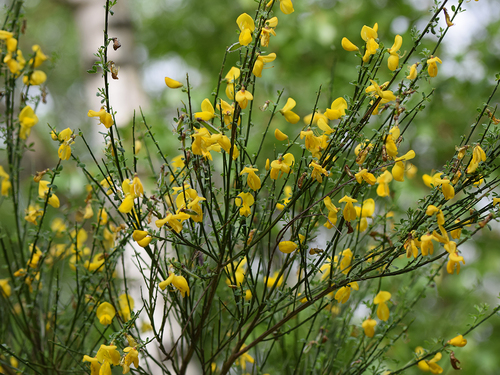
A vibrant but controversial guest in many landscapes, Scotch Broom is famous for its brilliant golden-yellow blooms and its 'explosive' method of spreading seeds. This hardy shrub turns hillsides into seas of gold every spring, providing a striking evergreen backdrop for backyard wildlife.
Quick Identification
Size
Height of 1–3 m (3–10 ft); spread of up to 2 m (6.5 ft)
Colors
Bright golden-yellow flowers; dark green, angled stems; small, inconspicuous dark green leaves
Key Features
- Bright yellow pea-shaped flowers
- Five-angled, ridged green stems that stay green all year
- Flat, brownish-black seed pods with fuzzy white hairs along the edges
- Small, three-part leaves on lower branches and single leaves on upper branches
When You’ll See Them
Geographic range
Where Does the Scotch Broom Live?
Originally native to the temperate regions of western and central Europe, Scotch Broom has successfully established itself across several continents. It is now widespread across the United Kingdom and much of mainland Europe, and has become a prominent, often invasive, feature of the landscapes in North America, particularly along the Pacific Coast and the Atlantic Northeast. It is also commonly found throughout Australia and New Zealand, where it was historically introduced for erosion control and garden ornamentation.
Basemap © OpenStreetMap contributors
Behavior
Scotch Broom is a highly successful colonizer known for its rapid growth and prolific seed production. As a pioneer species, it is often the first to inhabit disturbed soil, where it grows aggressively to form dense, monocultural thickets. Its most famous behavior is 'explosive dehiscence'; during the heat of mid-summer, the dried seed pods burst open with an audible 'pop,' flinging seeds several meters away from the parent plant to ensure wide dispersal.
While it provides a stunning visual display of yellow in the spring, it is a fierce competitor in the plant world. It produces biochemicals that can inhibit the growth of neighboring plants (allelopathy) and fixes its own nitrogen, allowing it to thrive in nutrient-poor soils where native species might struggle. For humans, it is a polarizing plant—admired for its beauty as an ornamental but frequently managed as a high-risk fire hazard and noxious weed in non-native regions.
EverydayEarth exclusive
Camera Tips
Capturing Scotch Broom on your backyard camera is less about catching a quick movement and more about documenting a seasonal transformation. To get the best shots of the vibrant yellow bloom, position your camera at a medium height—about 3 to 4 feet off the ground—angled slightly downward. Because the golden flowers are highly reflective, avoid placing the camera where it will face the direct midday sun, which can cause 'white-out' highlights; instead, aim for southern or eastern exposures to catch the softer morning light.
If you want to capture the 'action' of Scotch Broom, set your camera to a time-lapse mode during the hottest days of July and August. This is the only way to witness the explosive seed dispersal. Frame a cluster of dark, ripened pods against a contrasting background. If your camera has a high-sensitivity microphone, you might even record the distinct 'cracking' sound as the pods twist and fire their seeds into the surroundings.
For those using AI-powered cameras to track wildlife, Scotch Broom thickets are excellent 'staging areas.' Position your camera at the base of a broom patch where it meets a clearing. Many small mammals, like rabbits and woodrats, use the dense, low-hanging branches as cover from aerial predators. By focusing on these natural 'tunnels' at the bottom of the shrub, you are much more likely to trigger your camera on moving wildlife using the broom as a highway.
During the winter, the plant's evergreen stems provide a rare splash of color in a dormant yard. This makes it an ideal backdrop for bird photography. Set up your camera nearby with a bird feeder or water source; the rigid, upright stems of the Scotch Broom provide excellent perches for small songbirds waiting their turn at the feeder, allowing for clean, beautifully framed shots of species like finches and sparrows.
Similar Species
Species that look similar or are commonly confused with Scotch Broom.
Spanish Broom
Has round, smooth stems rather than angled ones, and highly fragrant flowers.
French Broom
Features much more abundant foliage with smaller leaves and clusters of 3-10 flowers at the ends of branches.
Gorse
Easily distinguished by its sharp, needle-like spines instead of soft green stems.
Frequently Asked Questions
Record Scotch Broom at your habitat
Connect a camera to start building your own species record — AI identifies every visitor automatically.