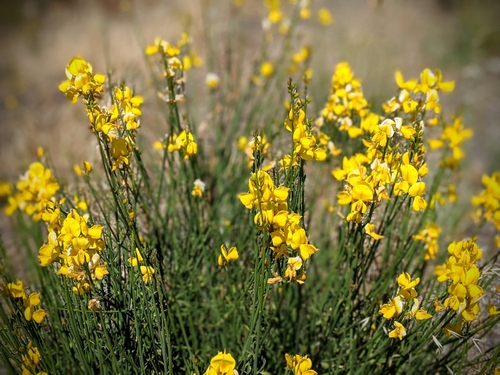
Spanish Broom
Spartium junceum
Spanish Broom is a Mediterranean marvel, painting hillsides in brilliant gold and filling the air with a sweet, honey-like perfume. Though its rush-like stems look delicate, this plant is a rugged survivor capable of thriving in the toughest soils.
Quick Identification
Size
Height of 2–4 m (6.5–13 ft); stem diameter up to 5 cm (2 in)
Colors
Vibrant golden-yellow flowers; dark olive-green stems; tiny, sparse bluish-green leaves
Key Features
- Bright yellow pea-like flowers in long clusters
- Cylindrical, rush-like green stems that are nearly leafless
- Intense, honey-sweet fragrance
- Upright, fountain-like growth habit with thin, switch-like branches
When You’ll See Them
Geographic range
Where Does the Spanish Broom Live?
Originally native to the Mediterranean regions of Southern Europe, North Africa, and the Middle East, Spanish Broom has become a globetrotting species. It is now widely established across the western United States, particularly along the Pacific Coast from California to Washington, as well as throughout parts of South America, Australia, and South Africa. This resilient shrub is a common sight in Mediterranean-style ecosystems and is frequently found colonizing disturbed hillsides and suburban edges across temperate zones worldwide.
Basemap © OpenStreetMap contributors
Behavior
Spanish Broom is a hardy, perennial shrub known for its remarkable ability to thrive in harsh, nutrient-poor environments. Unlike many plants, it performs the majority of its photosynthesis through its green, succulent stems rather than its leaves, which are small and short-lived. This adaptation allows it to conserve water and survive in Mediterranean climates with long, dry summers. In a backyard or wild setting, it often forms dense thickets that provide significant cover for small wildlife.
The plant is famous for its reproductive vigor. It produces large quantities of seeds housed in hairy pods that, when mature and dry, burst open with a distinct popping sound to scatter seeds several feet away. While it attracts a wide variety of pollinators such as honeybees and butterflies with its sweet scent, it is considered a highly invasive species in many parts of the world, including California and Australia, because it can quickly outcompete native vegetation and change the soil chemistry through nitrogen fixation.
EverydayEarth exclusive
Camera Tips
To capture the beauty of Spanish Broom, position your camera at a height of 3 to 4 feet, aimed at a dense patch of flowering racemes. Because the stems are thin and prone to swaying in the wind, use a faster shutter speed if your camera allows, or choose a sheltered location to avoid a blurred image. If you are using an AI-powered camera to detect pollinators, focus on the top third of the plant where the newest flowers bloom, as this is where bee and butterfly activity will be most concentrated.
For those interested in documenting the plant's unique biology, a time-lapse setting is ideal. Set your camera to take one photo every hour during the peak blooming months of May and June. This will allow you to see the rapid progression of the golden flowers and the eventual development of the fuzzy green seed pods. If you have a macro lens or close-up attachment, try to frame a single pea-shaped blossom to capture the intricate details of the keel and wing petals.
Placement is key when dealing with Spanish Broom's structure. Since it grows in a fountain-like shape, placing a camera low to the ground and tilting it upward at a 45-degree angle can create a dramatic "forest" effect with the green stems. Be mindful of the sun; the bright yellow petals reflect a lot of light, so try to position the camera with the sun at your back to avoid washing out the colors, or shoot during the 'golden hour' for a warm, glowing effect. Lastly, avoid placing motion sensors too close to flexible branches, as wind-driven movement can result in thousands of empty trigger events.
Similar Species
Species that look similar or are commonly confused with Spanish Broom.
Scotch Broom
Scotch Broom has distinct ridges on its square-ish stems and is usually smaller, whereas Spanish Broom has smooth, round, rush-like stems.
French Broom
French Broom is much leafier with small three-parted leaves that stay on the plant, unlike the almost leafless Spanish Broom.
Gorse
Gorse is covered in sharp, stiff spines and has much more compact, needle-like foliage compared to the smooth stems of Spanish Broom.
Frequently Asked Questions
Record Spanish Broom at your habitat
Connect a camera to start building your own species record — AI identifies every visitor automatically.