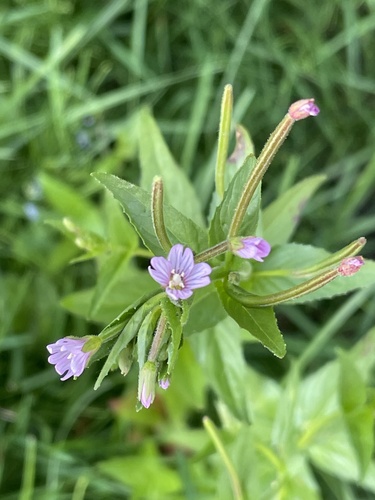
fringed willowherb
Epilobium ciliatum
A hardy and prolific wildflower, the fringed willowherb is a master of dispersal, using silky wind-blown seeds to colonize backyards and wetlands across the globe.
Quick Identification
Size
30 to 150 cm (12 to 60 inches) in height with flowers 3 to 6 mm (0.1 to 0.2 inches) wide.
Colors
Pale pink to white flowers; light green to reddish-purple stems; medium green leaves.
Key Features
- Small four-petaled pink or white flowers with deeply notched tips
- Elongated, slender seed capsules that split to reveal silky white hairs
- Opposite, lance-shaped leaves with fine teeth and distinct veins
- Stems featuring vertical lines of minute, curly hairs
When You’ll See Them
Geographic range
Where Does the fringed willowherb Live?
Fringed willowherb is natively widespread across a vast territory including nearly all of North America, from the subarctic reaches of Alaska and Canada down through the continental United States. It is also native to parts of East Asia and southern South America. Beyond its original home, it has become a highly successful introduced species across much of Eurasia and Australia, where it is now a common sight in both wild and developed temperate landscapes.
Basemap © OpenStreetMap contributors
Behavior
The fringed willowherb is a prolific and opportunistic colonizer, often appearing in gardens, roadsides, and damp areas shortly after the soil has been disturbed. It grows rapidly during the summer months, producing numerous small flowers that are self-pollinating but also attract a variety of small bees and hoverflies. Its primary survival strategy is its efficient seed dispersal; as the seed pods dry, they split longitudinally to release hundreds of tiny seeds equipped with silky white plumes that allow them to catch the wind and travel great distances.
Unlike many delicate wildflowers, fringed willowherb is remarkably resilient to human activity and urban pollution. It is frequently regarded as a garden weed because of its ability to thrive in pavement cracks and neglected plant containers. However, it plays a vital role in local ecosystems by providing quick ground cover in bare spots and supporting generalist pollinators that might otherwise struggle in highly developed suburban landscapes.
EverydayEarth exclusive
Camera Tips
Capturing the fringed willowherb on camera requires a focus on macro details and a steady hand. To get the best shots of its tiny, delicate flowers, set your camera at a low height, roughly 1 to 3 feet off the ground, using a tripod to ensure stability against the wind. Because the flowers are small—often less than half an inch wide—use a macro lens or a specialized "macro mode" to reveal the notched petals and the internal structure of the blossom. Angling the camera slightly upward can help silhouette the plant against the sky, which beautifully highlights the fine "fringed" hairs on the seed pods that give the species its name.
For those using AI-powered trail cameras or backyard monitors, place the device near a cluster of willowherb in early to mid-summer. While the plant is stationary, it acts as a magnet for insect activity. To capture pollinators like hoverflies or small solitary bees, set your camera to a "burst" mode or high-speed trigger. Since these plants thrive in moist areas, late morning is the ideal time for photography; the morning dew often clings to the silky seed plumes, creating a shimmering effect that is visually stunning when backlit by the rising sun.
Time-lapse photography is a fantastic way to document the life cycle of this species. Setting a camera to take a photo every 30 to 60 minutes over a period of two weeks can capture the dramatic transition from a closed bud to a blooming flower, and eventually the explosive splitting of the seed capsules. If you are trying to capture the seeds dispersing, choose a day with a gentle breeze and set your shutter speed as high as possible to freeze the motion of the white "parachutes" as they take flight. No bait or lure is needed for this species, but clearing away heavy foreground grass will ensure your AI camera stays focused on the willowherb's intricate features rather than moving blades of grass.
Similar Species
Species that look similar or are commonly confused with fringed willowherb.
Fireweed
Much larger with tall, showy spikes of bright magenta flowers and longer, willow-like leaves without visible teeth.
Hoary Willowherb
Covered in dense, soft gray hairs all over the stem and leaves, whereas fringed willowherb is mostly hairless except for specific lines on the stem.
Marsh Willowherb
Features much narrower leaves that are usually slightly curled downwards at the edges and lacks the distinct lines of hairs on the stem.
Frequently Asked Questions
Record fringed willowherb at your habitat
Connect a camera to start building your own species record — AI identifies every visitor automatically.