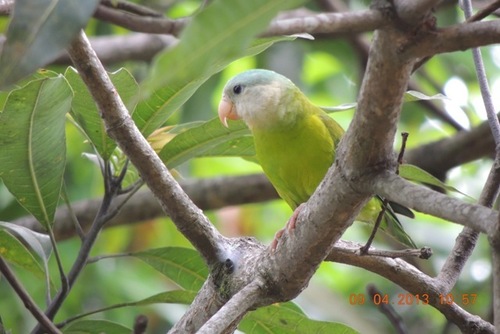
Gray-cheeked Parakeet
Brotogeris pyrrhoptera
A social and vibrant inhabitant of South America's western forests, the Gray-cheeked Parakeet is famous for its chattering personality and hidden orange wings. Though vulnerable in the wild, it remains a charismatic visitor to gardens and parks across its range.
Quick Identification
Size
20 cm (8 in) long; weight between 54-68g (1.9-2.4 oz)
Colors
Primary bright green body; greyish-white cheeks and forehead; blue-tinged crown; vivid orange patches under the wings
Key Features
- Distinctive pale grey cheeks and forehead
- Bright orange-yellow underwing coverts visible in flight
- Small, slender build with a pointed tail
- Pale horn-colored beak
When You’ll See Them
Geographic range
Where Does the Gray-cheeked Parakeet Live?
Native to the western edge of South America, the Gray-cheeked Parakeet is a regional specialty of the Tumbesian center of endemism. Its core native range spans from western Ecuador, particularly the Manabí and Guayas provinces, down into northwestern Peru in the Tumbes and Piura regions. Beyond its native home, small feral populations have become established in several major cities in the United States, including Los Angeles and Miami, following escapes from the pet trade.
Basemap © OpenStreetMap contributors
Behavior
The Gray-cheeked Parakeet is a highly social and energetic bird, typically observed in small, tight-knit flocks of 5 to 15 individuals. They are exceptionally vocal, maintaining contact with their group through a series of rapid, high-pitched chattering calls that can be heard from a significant distance. In the wild, they are acrobatic foragers, often seen hanging upside down from thin branches to reach ripening fruits or nectar-rich blossoms.
While they are naturally wary of predators, they have shown a remarkable ability to adapt to human-altered landscapes. In suburban areas of Ecuador and Peru, as well as in introduced urban populations, they frequent garden bird feeders and public parks. They spend the hottest part of the day resting in the shade of dense leafy canopies, becoming most active and visible during the cooler hours of the morning and late afternoon.
EverydayEarth exclusive
Camera Tips
To capture the best footage of Gray-cheeked Parakeets, position your camera near a reliable water source or a fruiting tree. Since these birds are strictly arboreal, mounting your camera at a height of 5 to 10 feet looking toward a known feeding branch or a high-rimmed birdbath is ideal. Use a wide-angle lens if possible, as they almost always travel in groups; capturing the social interactions between pairs and flock members adds significant value to your observations.
Baiting with fresh tropical fruits like papaya, mango, or even halved pomegranates can entice them into your camera's field of view. In suburban settings, they are particularly drawn to flowering balsa trees or fruiting figs. Ensure the camera is angled to catch the underside of their wings; the "fire-winged" orange flash is their most striking feature but is typically only visible when they stretch, preen, or take flight. Setting your camera to a high-speed burst mode or short video clips of 15-20 seconds is the most effective way to catch these brief flashes of color.
Good lighting is essential to resolve the subtle grey facial markings that give the species its name. Position your camera with the sun behind it to illuminate the birds directly during their peak activity hours. Avoid placing cameras in deep, shadowed thickets where their green plumage will blend perfectly into the foliage. A backdrop of open sky or lighter-colored building walls will help the bird stand out. If you are tracking a local population, keep your camera active during the dry season when these parakeets are most likely to descend to garden water features for a drink.
Similar Species
Species that look similar or are commonly confused with Gray-cheeked Parakeet.
Cobalt-winged Parakeet
Lacks the grey facial patch and features prominent blue on the wings instead of orange.
Yellow-chevroned Parakeet
Has a bright yellow patch on the wing 'shoulder' and lacks the grey forehead and cheeks.
Orange-chinned Parakeet
Smaller with a green face and a tiny, often hard-to-see orange spot just below the lower beak.
Frequently Asked Questions
Record Gray-cheeked Parakeet at your habitat
Connect a camera to start building your own species record — AI identifies every visitor automatically.