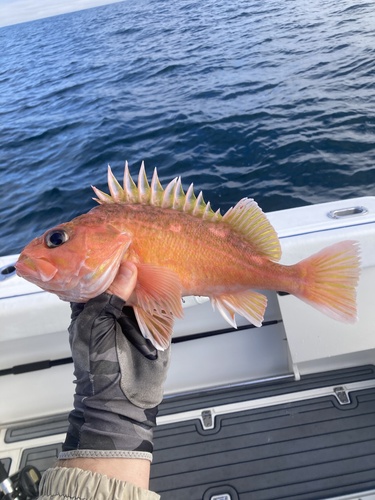
Greenblotched Rockfish
Sebastes rosenblatti
A master of deep-sea camouflage, the Greenblotched Rockfish is a stunning resident of the Pacific's rocky reefs. With its intricate green patterns and vivid orange hues, it remains one of the most visually striking fish of the California coast.
Quick Identification
Size
Typically 25–40 cm (10–16 inches) in length, reaching a maximum of 54 cm (21 inches); weights generally range from 0.5–2 kg (1–4.5 lbs).
Colors
Bright yellow-orange to pinkish-red base color with distinct greenish-brown blotches or worm-like markings (vermiculations) on the back; four pale spots visible along the dorsal fin base.
Key Features
- Intricate green vermiculations on upper body
- Four distinct white or pale spots along the base of the dorsal fin
- Long, sharp venomous spines on the dorsal and anal fins
- Large eyes adapted for low-light deep-water environments
When You’ll See Them
Geographic range
Where Does the Greenblotched Rockfish Live?
Native to the Eastern Pacific Ocean, the Greenblotched Rockfish is a North American coastal specialist. Its range extends from the chilly waters off San Francisco, California, down through the Channel Islands and across the border into central Baja California, Mexico. They are most concentrated along the rugged underwater escarpments of the Southern California Bight, where they favor the deep, nutrient-rich waters of the continental shelf.
Basemap © OpenStreetMap contributors
Behavior
The Greenblotched Rockfish is a largely solitary and sedentary species that spends most of its life near the ocean floor. They are known for their 'sit-and-wait' predatory style, often resting on rocky outcrops or hiding within crevices. Unlike more active schooling fish, they are highly territorial and may occupy the same small section of a deep-sea reef for years, hovering just inches above the substrate while waiting for prey to drift or swim by.
As a deep-water resident, they are rarely encountered by casual swimmers but are a common sight for ROV operators and deep-sea anglers. They are slow-growing and long-lived, reaching ages of up to 50 years. Their social interactions are limited primarily to the breeding season, though they may congregate in areas with exceptionally high-quality habitat or abundant food sources. While they possess venomous spines for defense, they are generally docile and will remain motionless if they feel their camouflage is working.
EverydayEarth exclusive
Camera Tips
Capturing the Greenblotched Rockfish requires specialized underwater equipment, as they reside far below the reach of standard backyard gear. For those using deep-sea drop cameras or ROVs (Remotely Operated Vehicles), placement is everything. Aim to position your camera near high-relief structures like rocky ledges, deep crevices, or artificial reefs. These fish prefer the edges of rock piles where they can hide while maintaining a clear view of the surrounding water column for potential prey.
Lighting is a critical factor at depths of 100+ meters where natural light is almost non-existent. While white LED arrays provide the best color for identifying the 'green blotches,' they can startle deep-sea life. If you want to observe natural, undisturbed behavior, consider using red-light filters. Many rockfish cannot see red light as easily, allowing you to catch them in their resting state. Ensure your camera is weighted heavily or anchored, as the currents along the California coast can be strong enough to shift lighter gear.
Because these fish are highly territorial and sedentary, time-lapse mode is often more effective than motion-triggering, which can be fooled by drifting kelp or marine snow. Set your camera to take a high-resolution still every 5 to 10 minutes. If you are using a baited camera (a 'BRUV' system), a small mesh bag of crushed sardines or squid can draw them out of their rocky hiding spots into the frame. Just be prepared for other scavengers to arrive first!
Similar Species
Species that look similar or are commonly confused with Greenblotched Rockfish.
Rosy Rockfish
Lacks the dense green 'worm-like' patterns and typically has a more uniform rosy-red color.
Starry Rockfish
Covered in many tiny white dots (stars) across the body, which the Greenblotched Rockfish lacks.
Speckled Rockfish
Has much smaller, more uniform dark spots rather than the large, intricate green blotches of S. rosenblatti.
Frequently Asked Questions
Record Greenblotched Rockfish at your habitat
Connect a camera to start building your own species record — AI identifies every visitor automatically.