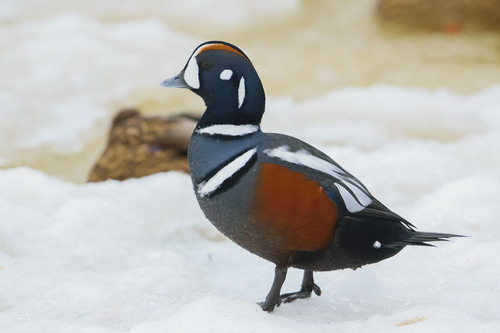
Harlequin Duck
Histrionicus histrionicus
Known as the 'painted duck,' the Harlequin thrives in the most violent waters on the planet. From mountain rapids to crashing sea surf, this small but hardy diver is a masterpiece of survival and color.
Quick Identification
Size
Length: 38-45 cm (15-18 in); Wingspan: 61-70 cm (24-28 in); Weight: 500-700 g (1.1-1.5 lbs)
Colors
Males are slate blue with chestnut-colored flanks and bold white patches; females are brownish-gray with three white spots on the head.
Key Features
- Slate blue plumage with complex white 'painted' markings (males)
- Distinct white spot behind the eye and at the base of the bill (females)
- Compact, stocky build with a small, stubby bill
- High-floating, buoyant posture even in turbulent whitewater
When You’ll See Them
Geographic range
Where Does the Harlequin Duck Live?
The Harlequin Duck is a specialist of the Northern Hemisphere, found across both the Pacific and Atlantic regions. In North America, they are most prevalent along the rocky coastlines of Alaska and the Pacific Northwest, as well as the rugged shores of the Atlantic Northeast from Greenland down to New England. They also maintain significant populations in Iceland and across the eastern reaches of Russia, making them a truly circumpolar species that follows cold, oxygen-rich currents.
Basemap © OpenStreetMap contributors
Behavior
Harlequin Ducks are the daredevils of the waterfowl world, specifically adapted to live in the most turbulent water environments on Earth. They spend their summers on fast-flowing mountain streams and their winters along rugged, rocky coastlines. Their bones are unusually thick, likely an evolutionary adaptation to survive the constant pounding of heavy surf and river rapids against jagged rocks. They are incredibly buoyant, floating like corks even in the middle of crashing waves.
Socially, Harlequins are quite gregarious during the winter, forming tight flocks that move and dive in unison. They are often called 'squeakers' because their vocalizations are high-pitched, mouse-like chirps rather than traditional quacks. While they are wary of human presence, they are focused foragers and can be observed closely if you remain still on a rocky shoreline where they habitually haul out to rest.
EverydayEarth exclusive
Camera Tips
To capture the Harlequin Duck on a trail camera, you must focus on 'haul-out' spots. During winter, these ducks have favorite flat-topped rocks or ledges just above the tide line where they rest and preen. Look for rocks covered in white guano or those that remain exposed during mid-tide. Mount your camera low—about 12 to 18 inches off the ground—on a nearby rock or a weighted tripod, angling it across the surface of the haul-out area to catch the bird's profile against the water.
Inland during the breeding season, look for large boulders in the middle of rushing mountain streams. Harlequins often take breaks in the 'eddy' or slack water just behind these rocks. Position your camera on the riverbank facing these mid-stream boulders. Because these birds move quickly and the water is constantly in motion, use a camera with a fast trigger speed (0.2s or less) and set it to take 3-5 photo bursts or high-frame-rate video (60fps) to avoid motion blur.
Lighting is your biggest challenge. The white patches on a male Harlequin's head are highly reflective and can easily 'blow out' in direct midday sun, losing all detail. Try to set your camera in spots that receive soft, morning light or are in partial shade. Additionally, ensure your equipment is salt-spray resistant if filming on the coast; use a waterproof housing and wipe the lens with a microfiber cloth frequently to prevent salt crust from ruining your shots.
Similar Species
Species that look similar or are commonly confused with Harlequin Duck.
Wood Duck
Wood Ducks prefer calm freshwater ponds and have a large green crest, whereas Harlequins prefer turbulent water and have slate-blue bodies.
Bufflehead
Buffleheads are smaller with a large white patch on the back of the head, lacking the complex white 'painted' stripes of the Harlequin.
Long-tailed Duck
Found in similar coastal habitats, but have much longer tail feathers and lack the chestnut-colored flanks of the male Harlequin.
Frequently Asked Questions
Record Harlequin Duck at your habitat
Connect a camera to start building your own species record — AI identifies every visitor automatically.