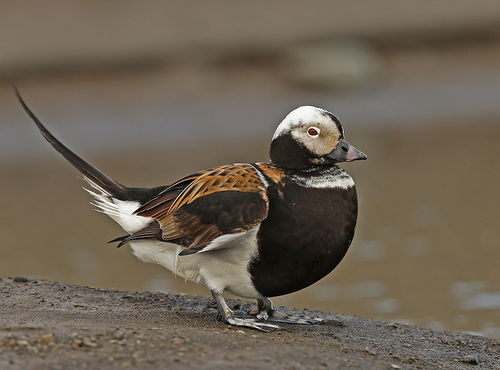
Long-tailed Duck
Clangula hyemalis
A deep-diving specialist of the Arctic, the Long-tailed Duck is famous for its elegant tail plumes and its haunting, musical calls that echo across winter coastlines.
Quick Identification
Size
Length: 38-58 cm (15-23 in); Wingspan: 71-80 cm (28-31 in); Weight: 650-1,100 g (1.4-2.4 lb)
Colors
Complex seasonal plumage. Winter males are mostly white with black/brown patches and long black tail streamers; females are brownish with a white face and dark crown.
Key Features
- Extraordinarily long, needle-like central tail feathers on males
- Distinctive dark cheek patch on a white head (winter plumage)
- Small, stubby bill with a pink band (males)
- Round-headed silhouette with a steep forehead
When You’ll See Them
Geographic range
Where Does the Long-tailed Duck Live?
The Long-tailed Duck is a true nomad of the north, claiming the vast circumpolar reaches of the Arctic as its summer breeding ground. From the remote Alaskan tundra to the frozen coastlines of Northern Russia, Greenland, and Canada, these resilient birds thrive in some of the harshest environments on Earth. As winter takes hold, they undertake impressive migrations to the ice-free coastal waters of the Atlantic and Pacific oceans, reaching as far south as the Mid-Atlantic United States and Central Europe.
Basemap © OpenStreetMap contributors
Behavior
The Long-tailed Duck is a master of the deep, renowned for its incredible diving abilities. Unlike most ducks that stay in shallow waters, these birds can dive to depths of 200 feet (60 meters) to forage on the ocean floor. They are highly social and are often seen in large, active flocks during the winter months, constantly shifting and leap-frogging over one another. Their movement is energetic and restless, making them a thrilling sight for coastal observers.
Known as one of the most vocal waterfowl species, they have a haunting, musical call that can be heard from a distance across the water. This "yodeling" is a constant feature of their social interactions. While they are generally wary of human proximity, they can become accustomed to observers in busy harbors or along popular piers where they seek shelter during winter storms.
EverydayEarth exclusive
Camera Tips
Capturing the Long-tailed Duck on a trail camera requires a coastal or Great Lakes shoreline setup during the winter months. Because these ducks spend most of their time on the water, place your camera on a low-profile mount or a sturdy stake at the water's edge, aimed toward jetties, breakwaters, or calm inlets where they congregate to rest. A low angle—ideally just 6 to 12 inches above the ground—provides an intimate perspective that captures the water's reflection and the bird's unique profile.
Since they are incredibly fast divers, camera settings are critical. Use a camera with a high-speed trigger (0.2s or faster) and set it to a multi-shot burst mode. This increases your chances of catching the male's long tail plumes as he shakes off water or performs a courtship display. If your camera allows for shutter speed priority, aim for 1/1000th of a second or faster to freeze the motion of splashing water and flapping wings during their frequent takeoffs.
Lighting is your best friend when photographing this species. Aim your camera toward the east or west to take advantage of the 'Golden Hour' light, which beautifully illuminates the stark whites and deep blacks of their plumage. Be mindful of the high contrast; on bright sunny days, you may need to underexpose slightly to prevent the white feathers from 'blowing out' and losing detail. During winter, ensure your camera is well-weatherproofed against salt spray if you are near the ocean, as sea salt can quickly corrode equipment.
Baiting is generally not effective or recommended for sea ducks, but you can increase your success by scouting for 'upwellings' or areas with high mussel concentrations. Long-tailed Ducks are creatures of habit and will often return to the same foraging spot day after day. If you notice a flock diving consistently in one area, that is the perfect place to leave your camera for a 48-hour session.
Similar Species
Species that look similar or are commonly confused with Long-tailed Duck.
Northern Pintail
Much longer neck and slender build; prefers shallow freshwater marshes over deep coastal waters.
Harlequin Duck
Darker overall plumage with complex white 'painted' markings; lacks the long tail streamers of the male Long-tailed Duck.
Bufflehead
Much smaller with a large, puffy white patch on the back of the head; lacks the long tail and dark breast of the Long-tailed Duck.
Frequently Asked Questions
Record Long-tailed Duck at your habitat
Connect a camera to start building your own species record — AI identifies every visitor automatically.