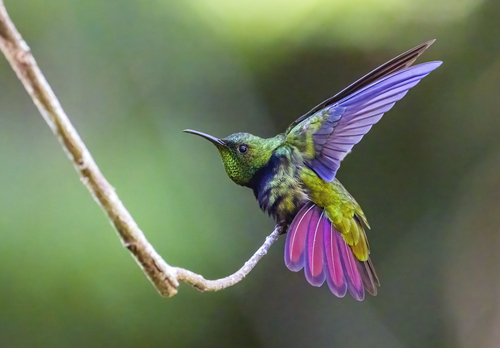
Hispaniolan Mango
Anthracothorax dominicus
A velvet-chested jewel of the Caribbean, the Hispaniolan Mango is a striking endemic hummingbird that brings vibrant color and bold energy to any garden. With its curved bill and shimmering purple tail, it is a master of the island's flowering landscapes.
Quick Identification
Size
11-12.5 cm (4.3-4.9 in) in length; weighs 4-7 g (0.14-0.25 oz)
Colors
Males are metallic bronze-green above with velvet-black underparts and a reddish-purple tail; females have grey-white underparts and white-tipped tail feathers.
Key Features
- Long, slightly decurved black bill
- Velvety black throat and breast in males
- Deeply forked, metallic reddish-purple tail
- Metallic bronze-green upperparts
- Large size compared to other island hummingbirds
When You’ll See Them
Geographic range
Where Does the Hispaniolan Mango Live?
The Hispaniolan Mango is a Caribbean specialist native to the island of Hispaniola. It is widely distributed across both the Dominican Republic and Haiti, as well as on several surrounding satellite islands like Ile de la Gonâve and Tortue. This resilient species occupies a vast range of environments, from sun-drenched coastal mangroves to the cooler elevations of inland mountain ranges.
Basemap © OpenStreetMap contributors
Behavior
The Hispaniolan Mango is a bold and conspicuous hummingbird known for its territorial nature. Unlike more secretive forest species, this bird is frequently seen in open habitats and urban gardens, where it vigorously defends high-quality nectar sources from both rivals and other bird species. It is a powerful flyer, capable of hovering for extended periods and performing impressive aerial maneuvers to snatch insects from the air.
These birds are often observed perching on high, exposed twigs or utility wires, which they use as vantage points to survey their territory. While they are primarily solitary, they are quite comfortable around human habitation and will readily visit backyard feeders and ornamental flowering hedges. Their flight is accompanied by a low-pitched humming sound, and they often pump their tails while hovering.
EverydayEarth exclusive
Camera Tips
To capture the iridescent brilliance of the Hispaniolan Mango, position your AI camera within 3 to 5 feet of a known nectar source, such as a sugar-water feeder or a flowering Cape Honeysuckle or Hibiscus bush. These birds are extremely fast, so ensure your camera is set to its highest frame rate or 'Sports' mode to capture sharp details of their wings. Good lighting is essential; aim for a spot that receives bright, indirect sunlight in the morning to highlight the velvet-black breast and the metallic purple tail without creating harsh shadows.
Since this species is territorial, look for a 'sentinel' branch—a bare twig or wire where the bird frequently perches between feedings. Focusing your camera on this spot will often yield better portraits than shooting at a feeder alone. Mount your camera at eye level (about 4.5 feet) and consider using a macro lens attachment if your device supports it, as these birds will often tolerate a camera being quite close once they are accustomed to its presence.
For backyard setups, consistency is key. Keep your feeders clean and filled with a standard 4:1 water-to-white-sugar ratio (avoid red dyes). In the tropical heat of Hispaniola, the nectar can ferment quickly, so change it every 48 hours to keep your subjects healthy and returning daily. Peak activity usually occurs shortly after sunrise, so ensure your camera batteries are fully charged for the dawn rush when the birds are most desperate to refuel.
Similar Species
Species that look similar or are commonly confused with Hispaniolan Mango.
Puerto Rican Mango
Virtually identical but geographically isolated; found only in Puerto Rico and the Virgin Islands.
Vervain Hummingbird
Much smaller (one of the world's smallest birds) with a straight bill and no black on the chest.
Hispaniolan Emerald
Smaller with a straighter bill and lacks the deep black underparts of the male Mango.
Frequently Asked Questions
Record Hispaniolan Mango at your habitat
Connect a camera to start building your own species record — AI identifies every visitor automatically.