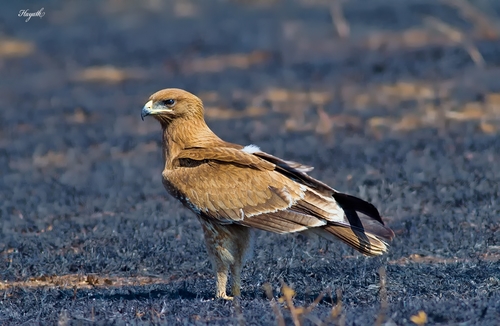
Indian Spotted Eagle
Clanga hastata
The Indian Spotted Eagle is a stoic sentinel of South Asia's open plains. A rare and vulnerable resident, this bird of prey is a prized sight for backyard observers and wildlife enthusiasts across the subcontinent.
Quick Identification
Size
Length: 60–65 cm (24–26 in); Wingspan: 135–160 cm (53–63 in); Weight: 1.1–1.5 kg (2.4–3.3 lbs)
Colors
Overall dark brown plumage; the head and neck are often a slightly paler earthy brown. Adults have yellow ceres and feet, while juveniles show white spotting on the wings.
Key Features
- Wide gape (mouth) extending back to the center of the eye
- Relatively long, slender bill
- Broad, rounded wings with 6-7 'fingers' at the tips
- Short, rounded tail compared to other large eagles
When You’ll See Them
Geographic range
Where Does the Indian Spotted Eagle Live?
The Indian Spotted Eagle is a characteristic resident of the South Asian subcontinent. Its core range spans across the plains and lowlands of India, where it is most concentrated, but it is also found in the neighboring regions of Pakistan, Nepal, Bangladesh, and Myanmar. Unlike many other eagles that navigate across continents, this species is largely a sedentary resident within these tropical and subtropical regions, remaining in its territory year-round as long as food sources are stable.
Basemap © OpenStreetMap contributors
Behavior
The Indian Spotted Eagle is a powerful but somewhat secretive predator typically seen alone or in pairs. Unlike many of its cousins that prefer dense forests or strictly aquatic environments, this species is a specialist of open habitats. It is frequently observed 'perch-hunting,' where it sits motionlessly on a high branch or telegraph pole for long periods, scanning the ground below for movement before launching a sudden, controlled strike.
While they are territorial, they are generally less aggressive toward humans than other raptors, though they will fiercely defend their nesting sites in the tall trees of village woodlots or forest edges. They spend a significant portion of the midday soaring on thermals, using their broad wings to cover vast distances with minimal effort. Their vocalizations are rare outside of the breeding season but consist of high-pitched, yelping calls.
EverydayEarth exclusive
Camera Tips
To capture the Indian Spotted Eagle on a trail camera, focus your efforts on the 'high-low' strategy. These eagles often descend to the ground to hunt or drink, but they spend most of their time on prominent perches. If you have a tall, isolated tree near an open field or a water source, mounting a camera on a nearby structure angled toward the eagle’s preferred branch can yield incredible 'eye-level' shots. Avoid placing cameras too low on the ground unless it is near a known watering hole in a dry area.
Lighting is crucial for this species because their dark brown plumage can easily lose detail in harsh midday shadows. Set your camera to trigger with a fast shutter speed to catch the moment of takeoff or landing. Because they are resident birds, they follow predictable routines; if you see one on a particular telegraph pole or branch once, there is a high probability they will return to that same spot daily. Look for 'whitewash' (droppings) on branches or the ground to identify these high-traffic areas.
Given their status as a Vulnerable species, it is vital to keep camera placement non-intrusive, especially during the nesting season (winter and spring). Do not use flash at night near nesting trees, as this can cause desertion. Instead, rely on high-quality passive infrared (PIR) sensors and natural light. If you are setting up near a garden or orchard on the outskirts of a village, a camera facing a clear patch of ground where rodents are active may capture the eagle mid-strike.
Similar Species
Species that look similar or are commonly confused with Indian Spotted Eagle.
Greater Spotted Eagle
Darker, heavier-set, and migratory; its mouth gape only reaches the front of the eye.
Tawny Eagle
Generally paler or more rufous in color with a more deeply 'split' gape and a different nostril shape.
Lesser Spotted Eagle
Found primarily in Europe and Africa; it is smaller with a less extensive gape than the Indian species.
Frequently Asked Questions
Record Indian Spotted Eagle at your habitat
Connect a camera to start building your own species record — AI identifies every visitor automatically.