Jack pine
Pinus banksiana
A resilient survivor of the North American wilderness, the Jack pine is a fire-adapted icon known for its twisted needles and curved, resin-sealed cones. It transforms barren, sandy soils into vibrant habitats for some of the continent's rarest birds.
Quick Identification
Size
Height of 9–22 m (30–70 ft) with a trunk diameter of 20–60 cm (8–24 in).
Colors
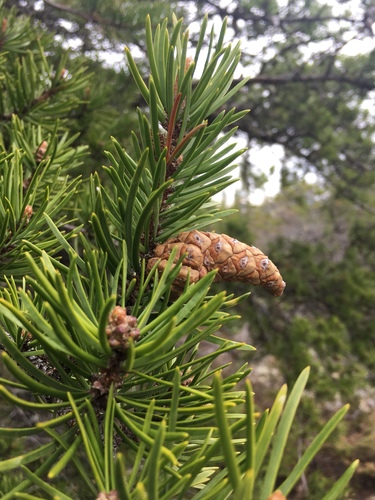
Yellowish-green to dark green needles; dark gray to reddish-brown scaly bark; tan to light brown resinous cones.
Key Features
- Short, twisted needles in bundles of two, 2–4 cm (1–1.5 in) long
- Cones are distinctly curved (hooked) and point toward the branch tip
- Irregular, gnarled growth habit compared to other straight-trunked pines
- Cones often remain sealed shut with resin for years.
When You’ll See Them
Behavior
The Jack pine is a rugged pioneer species, specifically adapted to thrive in harsh environments where other trees might fail. It is famous for its 'serotinous' cones, which are sealed shut by a thick resin. In a fascinating display of ecological survival, these cones typically only open to release their seeds when exposed to the intense heat of a forest fire. This allows the Jack pine to be the first to colonize the nutrient-rich ash left behind after a blaze.
In your backyard or local woodland, you'll notice the Jack pine often takes on a gnarled, asymmetrical appearance. Unlike the stately, straight trunks of the Red pine, the Jack pine’s branches often twist and turn, creating a dense, scrubby canopy. This structure provides excellent thermal cover for wildlife during harsh winters, and its seeds are a vital food source for specialized birds like the Red Crossbill.
EverydayEarth exclusive
Camera Tips
When using an AI-powered camera to capture a Jack pine, your best bet is to focus on the 'visitors' rather than just the tree itself. Frame your camera to include a cluster of mature cones. These cones are a magnet for squirrels and birds, particularly during the winter months when other food sources are scarce. Positioning the camera 5-8 feet away from a low-hanging branch will allow you to see the fine detail of the twisted needles and the unique hook of the cones while catching the action of foraging wildlife.
Because Jack pines are often found in open, sandy areas, light can be very harsh. For the best visual results, aim your camera north or south to avoid the direct glare of the rising or setting sun. If your camera has a time-lapse mode, the Jack pine is an excellent subject for a long-term study. Setting it to take one photo a day over the course of a year can beautifully document the shedding of old needles and the slow, persistent growth of new buds in the spring.
If you are looking to capture specific species like the Kirtland’s Warbler (in certain regions of the Midwest), you need to find young Jack pine stands where the trees are between 5 and 15 feet tall. Mount your camera at shoulder height, facing into a dense patch of young trees. These birds nest on the ground beneath the lower branches, so a low-angle shot looking upward toward the tree's interior can yield incredible rare footage of their nesting behaviors.
Similar Species
Species that look similar or are commonly confused with Jack pine.
Red Pine
Red pine has much longer needles (4-6 inches) that are not twisted, and its cones are egg-shaped without the Jack pine's curve.
Scots Pine
Scots pine has orange-colored bark on the upper trunk and its cones point away from the branch tip, unlike Jack pine.
Lodgepole Pine
Very similar but grows much straighter and taller; found primarily in Western North America whereas Jack pine is more Eastern/Central.
Frequently Asked Questions
Record Jack pine at your habitat
Connect a camera to start building your own species record — AI identifies every visitor automatically.