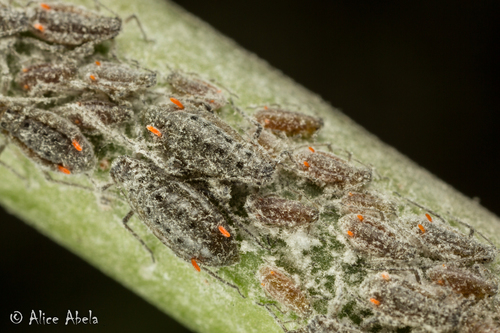
Large Waxy Willow Aphid
Plocamaphis flocculosa
Often mistaken for a patch of summer snow or fuzzy mold, the Large Waxy Willow Aphid is a master of disguise. These 'woolly' insects transform willow branches into bustling microscopic cities, complete with ant 'bodyguards' and intricate wax architecture.
Quick Identification
Size
3-6 mm (0.12-0.24 inches) in length; significantly larger than most common garden aphids
Colors
Body is dark brown to grey-black, but usually entirely obscured by dense, white, filamentous wax
Key Features
- Dense, cotton-like white wax covering
- Large, bulbous body visible beneath wax
- Exclusively found on willow (Salix) bark and twigs
- Often attended by large numbers of ants
When You’ll See Them
Behavior
The Large Waxy Willow Aphid is a gregarious insect that forms conspicuous colonies on the woody stems and branches of willow trees. Unlike many other aphid species that prefer the underside of leaves, these aphids tap directly into the bark to reach the nutrient-rich phloem sap. Their most distinctive behavior is the secretion of long, white waxy filaments that serve as a physical barrier against predators like ladybugs and lacewings, and may also help regulate moisture levels around the colony.
These aphids are famous for their mutualistic relationship with ants. Because they consume vast quantities of sap, they excrete a sugary liquid called honeydew. Ants act as 'ranchers,' protecting the aphid colony from predators and even cleaning the colony to prevent fungal growth, all in exchange for harvesting the honeydew. When the colony becomes overcrowded, winged individuals (alates) are produced to fly off and colonize new willow trees.
EverydayEarth exclusive
Camera Tips
To successfully capture the Large Waxy Willow Aphid on camera, you must focus on the host plant. Locate a willow tree in your yard and scan the trunk and lower branches for what looks like patches of white mold or cotton. These are your colonies. Because these insects are small, a standard trail camera will struggle with focus; you will need a camera with a dedicated macro mode or a macro lens attachment for your smartphone. Position the lens 3 to 6 inches away from the colony, ensuring the branch is stable and won't sway in the wind, which is the primary cause of blurry insect photos.
Lighting is your biggest challenge with this species. The brilliant white wax reflects light intensely, which often causes cameras to overexpose the image, resulting in a 'blown-out' white blob with no detail. For the best results, photograph them during 'golden hour' or on a bright but overcast day. If using a manual camera, dial down the exposure compensation (EV) to -1.0 or -2.0 to preserve the intricate textures of the waxy filaments. Avoid using a direct flash, as it will flatten the image and erase the delicate shadows between the wax strands.
Try setting your camera to time-lapse mode rather than motion-trigger. Because aphids move very slowly, motion sensors often fail to trigger. A time-lapse set to one frame every 30 seconds can reveal the fascinating social dynamics of the colony, including the constant movement of 'herding' ants and the occasional defensive shimmy the aphids perform when threatened. Look for the 'honeydew' droplets—small clear beads—being flicked away or collected by ants; capturing this interaction is the holy grail of aphid photography.
Similar Species
Species that look similar or are commonly confused with Large Waxy Willow Aphid.
Woolly Apple Aphid
Found on apple, hawthorn, and elm trees; smaller and produces a more 'sticky' looking wax than the willow variety.
Beech Blight Aphid
Exclusively found on Beech trees and known for their synchronized 'dancing' behavior when the colony is disturbed.
Giant Willow Aphid
Also found on willows, but lacks the thick white waxy covering and has a distinct 'shark fin' shape on its back.
Frequently Asked Questions
Record Large Waxy Willow Aphid at your habitat
Connect a camera to start building your own species record — AI identifies every visitor automatically.