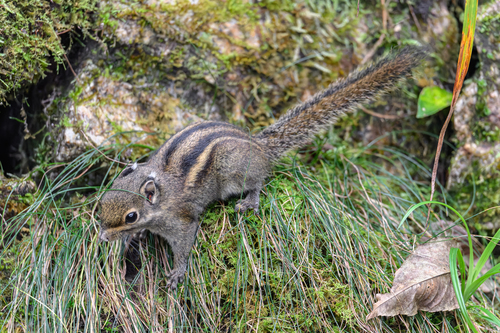
Maritime Striped Squirrel
Tamiops maritimus
A master of the canopy, the Maritime Striped Squirrel is a pint-sized acrobat distinguished by its striking racing stripes. Common in the gardens and forests of East Asia, this diurnal squirrel brings a burst of energy and bird-like chirps to any backyard.
Quick Identification
Size
Body length 10-15 cm (4-6 in); tail length 11-15 cm (4.5-6 in); weight 50-85g (1.8-3 oz)
Colors
Olive-brown to grayish-brown fur with five distinct dark longitudinal stripes separated by pale creamy-yellow stripes; pale buff underparts.
Key Features
- Five dark longitudinal stripes along the back
- Slender, bushy tail often held vertically
- Strictly arboreal behavior with rapid, jerky movements
- Small, pointed ears with white tufts in some subspecies
When You’ll See Them
Geographic range
Where Does the Maritime Striped Squirrel Live?
This charming squirrel is native to East and Southeast Asia, flourishing across southern and eastern China as well as the island of Taiwan. Its territory extends southward into the lush landscapes of Vietnam and Laos, specifically occupying regions east of the Mekong River. Within these areas, they are ubiquitous in both wild mountain forests and developed green spaces, showing a strong preference for humid, wooded environments.
Basemap © OpenStreetMap contributors
Behavior
The Maritime Striped Squirrel is a whirlwind of energy, spending most of its day navigating the canopy with incredible agility. Unlike ground-dwelling chipmunks which they closely resemble, these squirrels are strictly arboreal, rarely descending to the forest floor unless absolutely necessary. They are highly social and often seen in small groups or pairs, communicating with high-pitched chirps and whistles that can easily be mistaken for bird calls by the untrained ear.
In residential areas of East Asia, they have adapted remarkably well to human presence. They are frequently spotted in urban parks and backyard gardens where mature trees or trellises are present. While they aren't as bold as some larger squirrel species, their curiosity often leads them to investigate bird feeders or fruiting garden trees, making them a delight for backyard wildlife observers. They are most active during the daylight hours, with a noticeable lull during the hottest part of the afternoon.
EverydayEarth exclusive
Camera Tips
To capture the Maritime Striped Squirrel on camera, height is your best friend. Unlike many backyard mammals that scavenge on the ground, these squirrels are highly arboreal. Mount your AI-powered camera 5 to 10 feet up a tree trunk or on a sturdy branch facing a known travel route. Look for 'highways'—horizontal branches that connect different trees or lead toward food sources—as these are their primary corridors for movement.
Since they are diurnal, you won't need specialized night vision, but fast trigger speeds are essential. These squirrels move in quick, jerky bursts and can zip across a frame in milliseconds. If your camera has a 'burst mode' or high-speed video setting, enable it to ensure you catch more than just a blurry tail. Position the camera to face north if possible to avoid lens flare during their peak morning and afternoon activity hours, which is when the light is often most dramatic.
While they forage naturally, you can encourage a visit by providing high-energy treats. A platform feeder stocked with sunflower seeds, chopped fruit (like apples or bananas), or even a small smear of nut butter on a tree trunk can keep them stationary long enough for a clear, high-quality shot. In tropical regions, planting ginger or other nectar-rich flowers nearby can also act as a natural lure that mimics their wild diet, providing excellent opportunities for natural-looking behavior captures.
Similar Species
Species that look similar or are commonly confused with Maritime Striped Squirrel.
Swinhoe's Striped Squirrel
Found at higher elevations with slightly darker, more muted fur and less distinct pale stripes.
Himalayan Striped Squirrel
Smaller in size with shorter ears and a tail that is generally less bushy than the Maritime species.
Siberian Chipmunk
Primary ground-dweller with shorter tails and facial stripes that are much more prominent than those of Tamiops squirrels.
Frequently Asked Questions
Record Maritime Striped Squirrel at your habitat
Connect a camera to start building your own species record — AI identifies every visitor automatically.