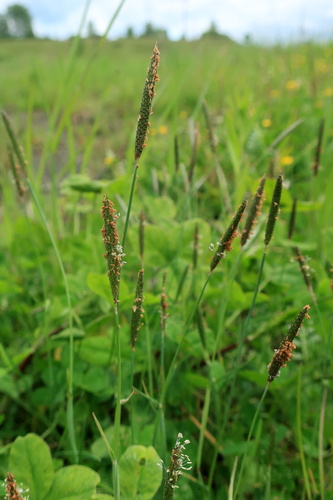
Marsh foxtail
Alopecurus geniculatus
A lover of mud and marshes, the Marsh foxtail adds a touch of fuzzy elegance to the wettest parts of your landscape. Look for its iconic 'kneed' stems and soft, cylindrical blooms that sway in the summer breeze.
Quick Identification
Size
Stems reach 15-45 cm (6-18 inches) tall; flower spikes are 2-7 cm (0.8-2.7 inches) long.
Colors
Blue-green to grayish-green foliage with pale green flower spikes that often turn purplish; conspicuous orange or yellow anthers during bloom.
Key Features
- Distinctly bent or 'kneed' stems at the lower joints
- Soft, cylindrical 'foxtail' flower heads
- Awns (tiny bristles) that protrude noticeably from the glumes
- Thrives in standing water or saturated, muddy soil
When You’ll See Them
Behavior
Marsh foxtail is a resilient perennial grass that specializes in colonizing the 'transition zones' between land and water. Unlike many grasses that drown in oversaturated soil, this species thrives with 'wet feet,' often growing directly out of shallow mud or at the edges of garden ponds. Its most famous characteristic is its growth habit; the stems are 'geniculate,' meaning they bend abruptly at the nodes like a human knee, allowing the plant to spread horizontally across mud before shooting upward.
While it doesn't move or hunt like an animal, Marsh foxtail 'behaves' by aggressively timing its flowering to the late spring and early summer. It is wind-pollinated, releasing clouds of pollen from its colorful orange anthers when the breeze is just right. In a backyard ecosystem, it provides critical structural cover for low-dwelling creatures like frogs and dragonflies, who use the sturdy, bent stems as perches.
EverydayEarth exclusive
Camera Tips
Capturing the Marsh foxtail on a backyard AI camera requires a different strategy than filming mobile wildlife. Because these grasses are relatively low-growing, place your camera on a ground-level stake or a very low tripod, roughly 6 to 12 inches off the deck. Angle the lens slightly upward to catch the 'foxtail' seed heads against the sky; this silhouette effect helps AI software distinguish the plant's unique shape from the background blur of a lawn.
Since plants don't trigger PIR (Passive Infrared) sensors that rely on heat, you should set your camera to 'Time Lapse' mode or use 'Motion Detection' with high sensitivity during windy days. The swaying motion of the foxtails is what will trigger most AI video captures. For the best visual results, position the camera so the sun is behind the plant (backlighting) during the 'Golden Hour' of late afternoon. This will illuminate the fine awns and bristles, making the seed head appear to glow and highlighting the orange anthers during the blooming phase.
If you are using an AI camera to monitor ecological health, focus on the 'kneed' joints of the stems. Setting your focal point on these bends can help document how the plant spreads throughout the season. Because Marsh foxtail grows in wet areas, ensure your camera housing is waterproof and elevated slightly above any potential standing water to avoid lens fogging or water damage during heavy rains, which is exactly when this species looks its most vibrant.
Similar Species
Species that look similar or are commonly confused with Marsh foxtail.
Meadow Foxtail
Much taller (up to 1 meter) and lacks the characteristic 'kneed' or bent joints at the base of the stem.
Timothy Grass
The flower spike is much harder and stiffer, and the plant prefers well-drained meadows rather than muddy marshes.
Yellow Foxtail
Belongs to the Setaria genus; it has long, yellowish bristles (involucral bristles) that give it a much 'hairier' appearance than the soft Marsh foxtail.
Frequently Asked Questions
Record Marsh foxtail at your habitat
Connect a camera to start building your own species record — AI identifies every visitor automatically.