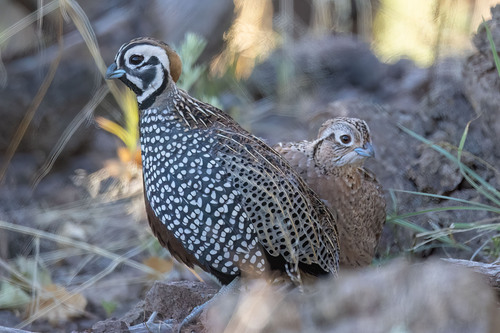
Montezuma Quail
Cyrtonyx montezumae
Meet the 'Harlequin of the Woods,' a master of camouflage with one of the most striking facial patterns in the bird world. This secretive resident of the Southwest mountain ranges is a rare and rewarding find for any backyard observer.
Quick Identification
Size
Length of 17-24 cm (7-9.5 in); Weight typically ranges from 150-200 g (5.3-7 oz).
Colors
Males feature a striking black-and-white harlequin facial pattern with white polka dots on dark flanks and a cinnamon belly. Females are cryptically colored in mottled browns and buffs.
Key Features
- Bold black and white facial mask on males
- White spots on dark grey or black flanks
- Round, stocky build with an extremely short tail
- Large, powerful feet used for digging bulbs
When You’ll See Them
Geographic range
Where Does the Montezuma Quail Live?
Native to the mountainous regions of North America, the Montezuma Quail is a signature species of the 'Sky Islands' in the Southwestern United States and the Mexican Highlands. Its core range extends from southeastern Arizona, southern New Mexico, and parts of west Texas southward through the Sierra Madre Occidental and Oriental in Mexico. It is almost exclusively found in high-elevation oak-pine woodlands where summer monsoons provide the moisture needed for their favorite food plants.
Basemap © OpenStreetMap contributors
Behavior
The Montezuma Quail is famously secretive, often relying on its exquisite camouflage to remain undetected. Unlike many birds that flush at the first sign of danger, this species will 'freeze' and crouch low in the grass until a predator is nearly on top of them—a trait that earned them the nickname 'Fool Quail' because they appear to be unaware of the danger.
These birds are highly terrestrial and spend the vast majority of their time on the ground. They are unique among quail for their specialized foraging technique: they use their oversized claws to dig for bulbs and tubers. They are social birds, usually found in small family groups called coveys, consisting of 6 to 10 individuals that stay together throughout the winter.
EverydayEarth exclusive
Camera Tips
To capture the elusive Montezuma Quail, you must think low. These birds spend nearly all their time walking on the forest floor, so mount your camera no higher than 6 to 10 inches off the ground. Aim the lens parallel to the earth across a small clearing or an established game trail near dense bunchgrass. Because they rely on camouflage, they often travel along the edges of cover rather than crossing wide-open spaces.
Unlike many backyard birds, Montezuma Quail aren't easily drawn to standard birdseed in hanging feeders. Instead, look for 'diggings'—small, conical holes in the soil where they have been searching for tubers. Placing a camera near these fresh foraging sites or near a shallow ground-level water source during the dry season (early summer) is your best bet for a clear shot. They are particularly active in the mid-morning once the dew has dried.
Set your camera to 'Burst Mode' or high-speed video. Because they move with a jerky, chicken-like gait and are prone to sudden freezes, having a series of photos increases your chances of catching that perfect profile of the male's harlequin mask. Ensure your trigger speed is fast; although they move slowly while foraging, they can disappear into the grass in a heartbeat if startled.
Similar Species
Species that look similar or are commonly confused with Montezuma Quail.
Gambel's Quail
Has a prominent black head plume and longer tail; typically found in lower desert elevations.
Scaled Quail
Lacks the bold facial mask; has a scaly feather pattern and a white-tipped crest.
Mountain Quail
Features a very long, straight head plume and chestnut throat, found further west in California and the Pacific Northwest.
Frequently Asked Questions
Record Montezuma Quail at your habitat
Connect a camera to start building your own species record — AI identifies every visitor automatically.