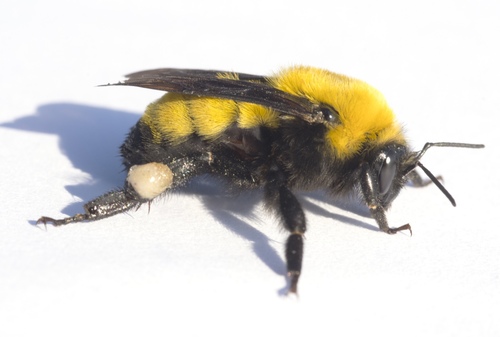
Morrison's Bumble Bee
Bombus morrisoni
The Morrison's Bumble Bee is the golden icon of the American West. With its fuzzy yellow coat and industrious spirit, this essential pollinator is a favorite sight for backyard observers from British Columbia to Mexico.
Quick Identification
Size
Queens: 21–23 mm (0.8–0.9 in); Workers: 11–19 mm (0.4–0.7 in); Males: 13–18 mm (0.5–0.7 in)
Colors
Brilliant golden-yellow hair on the thorax and the first 3-4 segments of the abdomen; black hair on the face, legs, and the tip of the abdomen.
Key Features
- Extensive golden-yellow hair covering the front half of the abdomen
- Black hair on the face and head (distinguishing it from similar species)
- Robust, large body typical of western bumblebees
- Short tongue length compared to other Bombus species
When You’ll See Them
Behavior
Morrison's Bumble Bee is a social, ground-nesting insect that plays a critical role in the ecosystems of western North America. Each year begins with a solitary queen who has overwintered in a small underground chamber. In early spring, she emerges to find a suitable nesting site—frequently an abandoned rodent burrow—where she begins the arduous task of foraging for pollen and nectar to raise her first generation of female workers. Once these workers emerge, they take over the foraging duties, allowing the queen to focus entirely on egg-laying.
These bees are remarkably efficient 'buzz pollinators.' This involves the bee grasping a flower and rapidly vibrating its flight muscles, which dislodges stubborn pollen from the anthers of plants that other bees might struggle to pollinate. While they are generally peaceful and focused on their work, they are most active during the warmest parts of the day, darting between flowers with a purposeful, low-pitched hum. In late summer, the colony produces new queens and males; after mating, the original colony and the males perish, leaving the new queens to find a safe spot to hibernate until the following spring.
EverydayEarth exclusive
Camera Tips
To capture high-quality footage of Morrison's Bumble Bee, you need to focus on 'pollinator hotspots' rather than wide-open spaces. Identify a patch of their favorite flowers, such as native sunflowers or Rabbitbrush (Ericameria), and set your camera on a tripod or mount just 12 to 18 inches away from the blooms. Because these bees move quickly, a camera with a fast trigger speed or the ability to record 60fps (frames per second) video is ideal for freezing the motion of their wings and capturing the detail of their golden hair.
Position your camera at a 45-degree angle to the flowers. This 'side-on' view is best for identifying the species, as it allows you to see both the black face and the distinctive yellow bands on the abdomen simultaneously. If your camera has an AI-triggering system, set the sensitivity to high to ensure the small, fast movement of the bee registers. Avoid placing the camera where it will be in direct shadow; these bees are most active in bright sunlight, and natural light is necessary to make their vibrant yellow coloring pop against the green foliage.
In the heat of mid-summer, bumblebees often visit backyard water features or 'bee bars' (shallow dishes of water with pebbles for landing). Placing a camera near a water source during a dry spell can provide unique behavior shots of bees drinking. For the most artistic shots, aim for the 'golden hour' in the late afternoon when the low sun backlights the bee's fuzzy coat, creating a glowing halo effect. If you find a nest entrance in the ground, keep your camera at least 3 feet away to avoid obstructing their flight path or disturbing the colony's temperature regulation.
Similar Species
Species that look similar or are commonly confused with Morrison's Bumble Bee.
Golden Northern Bumble Bee
The Golden Northern has a black stripe across the thorax between the wings and a longer, more triangular face.
Hunt's Bumble Bee
Hunt's Bumble Bee features a bright orange-red band in the middle of its abdomen, whereas Morrison's is entirely yellow and black.
Nevada Bumble Bee
The Nevada Bumble Bee is also quite yellow, but it typically has yellow hair on its face, while the Morrison's face is strictly black.
Frequently Asked Questions
Record Morrison's Bumble Bee at your habitat
Connect a camera to start building your own species record — AI identifies every visitor automatically.