Mountain Sage
Salvia regla
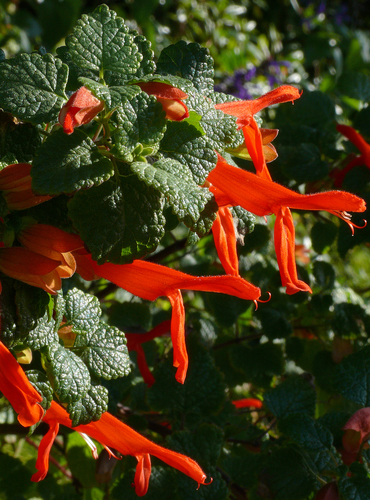
Known as the 'Queen of the Chisos,' Mountain Sage is a spectacular scarlet-flowered shrub that fuels the epic migrations of North American hummingbirds. Its dramatic late-summer blooms and rugged character make it the ultimate centerpiece for any high-desert or pollinator-focused backyard.
Quick Identification
Size
Height of 0.9–1.8 m (3–6 ft) and a spread of 0.9–1.2 m (3–4 ft)
Colors
Brilliant scarlet to vermillion red flowers with dark green, heart-shaped foliage
Key Features
- Large, tubular scarlet flowers up to 2 inches long
- Roughly textured, heart-shaped (deltoid) green leaves
- Woody, shrub-like growth habit
- Reddish-green calyxes that hold color after blooms fall
When You’ll See Them
Geographic range
Where Does the Mountain Sage Live?
Native to the rugged landscapes of North America, Mountain Sage finds its primary home in the high-elevation woodlands of the Chisos Mountains in West Texas. Its reach extends significantly south into Mexico, spanning the states of Coahuila, Durango, and Oaxaca, where it clings to rocky slopes and mountain passes. Because of its popularity as a 'pollinator magnet,' it has been widely introduced to residential gardens across the southern United States to bolster the migratory paths of hummingbirds.
Basemap © OpenStreetMap contributors
Behavior
In the garden or the wild, it exhibits a semi-woody structure that provides sturdy perches for its avian visitors. During the winter, it enters a dormant state, dropping its leaves to survive the colder mountain temperatures before rebounding with lush, rapid growth in the spring. It is highly drought-tolerant once established, making it a social and ecological anchor in arid mountain ecosystems.
EverydayEarth exclusive
Camera Tips
To capture the high-speed action of hummingbirds visiting your Mountain Sage, position your AI-powered camera within 2 to 3 feet of the most densely clustered flower spikes. Since the plant can reach 6 feet in height, mounting your camera on a tripod at mid-shrub level—roughly 4 feet high—will provide the best eye-level view of the birds as they hover to feed. Angle the lens slightly downward to capture the contrast between the scarlet flowers and the dark green foliage.
Lighting is crucial for iridescent bird feathers; place your camera so the morning sun (7 AM to 10 AM) hits the front of the flowers. This is when nectar production is at its peak and bird activity is highest. Set your camera's shutter speed to 'fast' or 'sport' mode if available, as the wingbeats of a Lucifer or Black-chinned Hummingbird are too quick for standard motion triggers. If your camera allows for zone-based triggering, focus on the area just in front of the tubular blooms.
Because Mountain Sage is a seasonal powerhouse, ensure your cameras are active and fully charged starting in early August. In the Texas flyway, the 'magic window' for capturing rare migratory species like the Rufous or Broad-tailed Hummingbird occurs between late September and mid-October. Use a neutral background, like a wooden fence or distant hedge, to make the vibrant red flowers and the visiting birds pop in your captures.
Similar Species
Species that look similar or are commonly confused with Mountain Sage.
Autumn Sage
Smaller, oval leaves and shorter flowers; blooms throughout spring and fall rather than one late-season burst.
Cedar Sage
A much smaller, shade-loving perennial with scalloped leaves that grows low to the ground.
Tropical Sage
An upright, thinner-leaved plant with smaller flowers that thrives in humid, low-elevation environments.
Frequently Asked Questions
Record Mountain Sage at your habitat
Connect a camera to start building your own species record — AI identifies every visitor automatically.