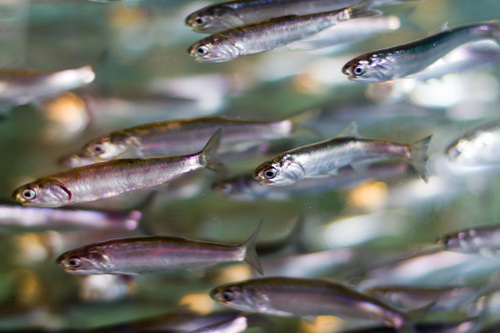
Northern Anchovy
Engraulis mordax
The shimmering silver engine of the Pacific ecosystem. These tiny but mighty schooling fish are the vital link between plankton and the ocean's greatest predators.
Quick Identification
Size
Typically 10-15 cm (4-6 inches) in length, reaching a maximum of 23 cm (9 inches). Weight is usually less than 100g (3.5 oz).
Colors
Metallic blue or greenish-blue along the back, shimmering silver sides and belly; often appearing somewhat translucent.
Key Features
- Exceptionally large mouth extending well past the eye
- Deeply forked tail fin
- Broad silver stripe running along the side
- Slender, cigar-shaped body profile
When You’ll See Them
Behavior
Northern Anchovies are the socialites of the Pacific, living in massive, tightly-packed schools that can number in the millions. This "safety in numbers" strategy is their primary defense against an endless list of predators, including humpback whales, sea lions, and numerous seabird species. They are highly migratory, moving between the deep, cold waters of the open ocean and the sheltered, nutrient-rich environments of bays and estuaries to spawn and forage.
As a keystone species, their presence dictates the health of the entire coastal ecosystem. Their populations are famous for "boom and bust" cycles; during years with cold-water upwellings, their numbers explode, providing a feast for marine life, while warmer water years may see their numbers dwindle as Pacific Sardines take their place. For humans, they are mostly encountered by pier fishers or seen in massive shimmering clouds beneath boat docks.
EverydayEarth exclusive
Camera Tips
Capturing the Northern Anchovy requires an underwater perspective, typically achieved using a tethered waterproof camera or a specialized underwater housing mounted to a dock piling or pier. Position your camera about 2 to 5 feet below the surface in areas where current or tidal flow is present, as these fish often face into the current to feed. These fish are highly sensitive to rapid movement, so a stationary, camouflaged setup attached to a fixed structure works best to avoid spooking the school.
While you do not need traditional bait to attract them, Northern Anchovies are highly attracted to artificial light at night. A submerged LED light or even a strong light shining from a pier onto the water can draw in massive "bait balls" of anchovies, providing a spectacular view of their synchronized schooling behavior. During the day, mounting the camera at a slight upward angle towards the surface can catch the natural "backlighting" of the sun, which makes their silver scales shimmer and pop against the dark water.
Because these fish move in rapid, shimmering bursts, use a high frame rate setting on your camera—at least 60 frames per second (fps)—to avoid motion blur and to allow for smooth slow-motion playback. Ensure your white balance is set for "underwater" or "cloudy" to combat the natural blue or green tint of Pacific coastal waters. In terms of timing, the best footage is often captured during high tide in coastal bays when the water clarity is at its peak and the schools move closer to shore-side structures to escape larger ocean predators.
Similar Species
Species that look similar or are commonly confused with Northern Anchovy.
Pacific Sardine
Larger body with a series of dark spots along the side and a much smaller mouth that does not extend past the eye.
Pacific Herring
Lacks the distinct silver lateral stripe and has a more symmetrical, smaller mouth compared to the anchovy.
Topsmelt Silverside
Has two dorsal fins instead of one and a much smaller mouth suited for picking at algae and small crustacea.
Frequently Asked Questions
Record Northern Anchovy at your habitat
Connect a camera to start building your own species record — AI identifies every visitor automatically.