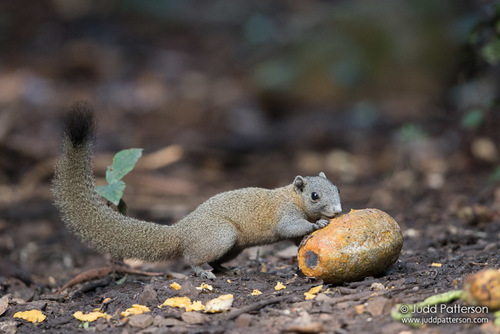
Northern Gray-bellied Squirrel
Callosciurus caniceps
A silver-bellied acrobat of the Asian canopy, the Northern Gray-bellied Squirrel is a master of the treetops. From the deep rainforests of Thailand to busy suburban gardens, this agile climber is a favorite for backyard observers.
Quick Identification
Size
Head and body 18–25 cm (7–10 in); tail 17–25 cm (6.7–10 in); weight 160–330 g (5.6–11.6 oz)
Colors
Agouti-grey or olive-brown upperparts; consistently pale grey or silvery-grey belly; tail often has a dark or blackish tip.
Key Features
- Uniform pale grey or silvery belly
- Olive-grey to yellowish-brown upperparts
- Bushy tail often held in a 'U' shape
- Lacks lateral stripes found on similar species
When You’ll See Them
Geographic range
Where Does the Northern Gray-bellied Squirrel Live?
Native to the lush tropical and subtropical regions of Southeast Asia, the Northern Gray-bellied Squirrel is most commonly found throughout Peninsular Malaysia, Thailand, and southern Myanmar. Its range reaches northward into the Yunnan province of southern China and likely extends into western Laos. Interestingly, this species has also successfully established itself as an introduced population in the Ryukyu Islands of Japan, demonstrating its impressive ability to thrive in new environments.
Basemap © OpenStreetMap contributors
Behavior
The Northern Gray-bellied Squirrel is a highly active and agile arboreal rodent, spending the vast majority of its time navigating the mid-to-upper canopy of trees. They are remarkable acrobats, capable of making daring leaps between branches to find food or escape predators. While primarily solitary, they are not strictly territorial and can often be seen in small groups where food is abundant, such as in a fruiting mango or durian tree.
These squirrels are known for their vocal nature, using a series of rhythmic chirps and 'u-u-u' barks to communicate with others or sound the alarm when a hawk or snake is nearby. In suburban areas, they have become remarkably bold and habituated to human presence, frequently using telephone wires as aerial highways to bypass ground-level obstacles. They are most active during the daylight hours, particularly in the cooler periods of the early morning and late afternoon.
EverydayEarth exclusive
Camera Tips
To capture the best footage of a Northern Gray-bellied Squirrel, mount your AI camera roughly 5 to 7 feet high on a tree trunk or a horizontal branch. These squirrels are arboreal, so aiming the camera at 'branch bridges'—spots where branches from different trees overlap—is a high-percentage strategy for catching them in transit. If you have fruit trees in your yard, position the camera about 8 feet away from the ripening fruit for the best action shots.
Using a lure can significantly increase your success rate. A small amount of peanut butter or nut butter smeared directly onto the bark within the camera's field of view will encourage the squirrel to stop and lick, giving the AI enough time to trigger and capture a clear, focused image. You can also place sliced bananas or sunflower seeds on a platform feeder; however, be mindful that they are very fast, so set your camera to a 3-shot burst mode to ensure you don't just catch a tail leaving the frame.
Lighting is key for this species as their grey fur can blend into the shadows of the canopy. Try to position your camera so the morning sun illuminates the area. Since they are strictly diurnal, you can disable the infrared night-vision trigger to save battery life. During the dry season, they may descend to the ground more often for water, so a camera aimed at a backyard birdbath or a low-profile water dish can provide excellent, rare footage of them drinking.
Similar Species
Species that look similar or are commonly confused with Northern Gray-bellied Squirrel.
Pallas's Squirrel
Almost identical in size, but Pallas's Squirrel has a distinct deep red or orange belly instead of pale grey.
Plantain Squirrel
Recognizable by the black and buff 'racing stripes' on its flanks and its buff-colored belly.
Black-striped Squirrel
Smaller in size with a very prominent dark stripe running down the side of its body.
Frequently Asked Questions
Record Northern Gray-bellied Squirrel at your habitat
Connect a camera to start building your own species record — AI identifies every visitor automatically.