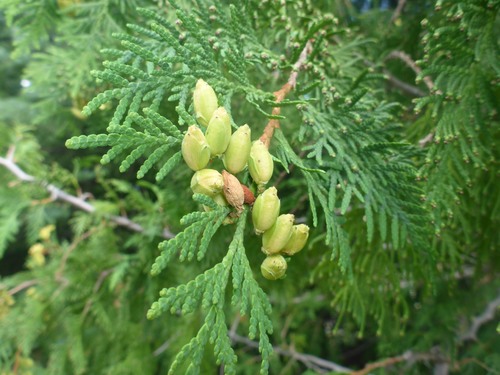
northern whitecedar
Thuja occidentalis
Often called the 'Arborvitae' or Tree of Life, the northern whitecedar is a cornerstone of the northern forest. This resilient evergreen provides critical winter shelter for wildlife and adds a timeless, aromatic beauty to any landscape.
Quick Identification
Size
Height: 10–15 meters (33–50 feet); Trunk diameter: 0.3–0.9 meters (1–3 feet); occasionally reaching 30 meters.
Colors
Bright green to yellow-green scale-like foliage; reddish-brown to gray fibrous bark.
Key Features
- Flat, fan-like sprays of scale-like leaves
- Small, upright woody cones (10-15mm) that turn brown with age
- Fibrous, shreddy bark that peels in long vertical strips
- Distinctive 'cedar' aroma when foliage is crushed
When You’ll See Them
Geographic range
Where Does the northern whitecedar Live?
The northern whitecedar is a quintessential species of the North American Great Lakes and St. Lawrence regions. It is native to eastern Canada, stretching from southeastern Manitoba to Nova Scotia, and extends into the northeastern and north-central United States as far south as the Appalachian Mountains. While its core population thrives in the boreal transition zones of Ontario, Quebec, and Maine, it is also widely introduced across Europe and other temperate regions as a popular ornamental hedge.
Basemap © OpenStreetMap contributors
Behavior
Northern whitecedar is a remarkably resilient evergreen that often grows in dense, pure stands known as 'cedar swamps.' Known historically as the 'Arborvitae' or 'tree of life,' it is famous for its extreme longevity; some specimens growing on limestone cliffs in the Great Lakes region are over 1,000 years old. It plays a critical role in the ecosystem by providing 'deer yards'—dense shelters where white-tailed deer congregate during harsh winters to find warmth and protection from deep snow.
In a backyard setting, this species is highly valued for its dense, symmetrical growth habit, making it a favorite for natural privacy screens and windbreaks. While it grows relatively slowly, its ability to tolerate wet soils and its resistance to most rot and insects makes it a staple of the northern landscape. It interacts with humans primarily through its use in rot-resistant fencing and its pervasive presence in ornamental landscaping.
EverydayEarth exclusive
Camera Tips
While the northern whitecedar itself is stationary, it is one of the best 'hub' species for trail camera placement. Because its dense foliage provides excellent thermal cover, placing a camera near a stand of whitecedars—especially in winter—is a surefire way to capture white-tailed deer, snowshoe hares, and various owl species. Position your camera at about 3-4 feet high, angled toward a natural opening in the cedar grove or along a well-worn trail leading into the thicket.
For those interested in the tree's growth or seasonal changes, a time-lapse setting is ideal. Set your AI-powered camera to take one photo every 24 hours to observe the slow ripening of the small cones from green to brown, or to watch the heavy winter snow accumulate on the flexible, fan-like branches. The tree's dense structure often causes 'false triggers' during high winds; if your camera has sensitivity settings, dial them back slightly or ensure no low-hanging cedar fronds are directly in the sensor's immediate path.
In a backyard environment, use these trees as a natural backdrop for a bird feeder station. Songbirds like Pine Siskins and Cedar Waxwings (who are named after this tree) frequently visit for cover. Place the camera 5-10 feet away from the tree's perimeter to capture the high-traffic 'edge zone' where wildlife moves from the safety of the cedar branches into the open. This setup is particularly effective during the golden hours of dawn and dusk when the reddish bark takes on a warm, glowing hue.
Similar Species
Species that look similar or are commonly confused with northern whitecedar.
Eastern Redcedar
Actually a juniper, it has prickly juvenile foliage and round, blue, berry-like cones unlike the flat sprays of whitecedar.
Western Redcedar
Grows much larger and is native to the Pacific Northwest; it has distinct white 'butterfly' markings on the underside of the leaves.
Atlantic White Cedar
Found in coastal swamps, its foliage sprays are more rounded and three-dimensional rather than perfectly flat fans.
Frequently Asked Questions
Record northern whitecedar at your habitat
Connect a camera to start building your own species record — AI identifies every visitor automatically.