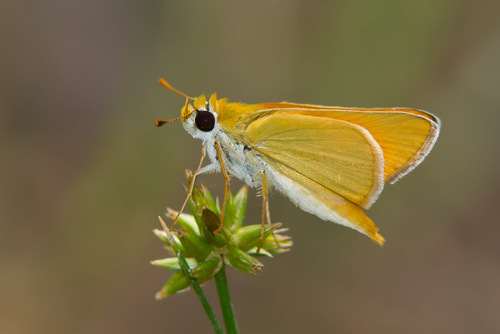
Orange Skipperling
Oarisma aurantiaca
A tiny, golden gem of the grasslands, the Orange Skipperling is a master of low-altitude flight. Though small, its vibrant orange hue and unique 'jet-wing' posture make it a favorite for backyard macro-photography.
Quick Identification
Size
Wingspan of 20–26 mm (0.8–1.0 inches). They are exceptionally small, often roughly the size of a fingernail.
Colors
Bright golden-orange on the upper side; the underside of the hindwing is a pale, tawny yellow with subtle white-scaled veins.
Key Features
- Vibrant, unspotted orange upper wings
- Unique 'skipper' resting pose with forewings angled and hindwings flat
- Pale white veining on the underside of the hindwings
- Extremely small size and rapid, darting flight pattern
When You’ll See Them
Behavior
The Orange Skipperling is a high-energy flier that stays close to the ground, weaving through tall grasses and low-growing wildflowers. Unlike the graceful, fluttering flight of larger butterflies, this species moves with a rapid, vibrating motion that can make it difficult to track with the naked eye. They are primarily solitary and spend most of their time searching for nectar or suitable grasses for egg-laying.
One of their most charming behaviors is their resting posture. They frequently land on grass blades to sun themselves, holding their wings in a way that resembles a tiny fighter jet. They are very sensitive to movement and light; even a passing cloud or a human shadow will cause them to zip away into the safety of thicker vegetation. Because they are so small, they often go unnoticed unless you are looking specifically at the tops of grasses in the mid-day sun.
EverydayEarth exclusive
Camera Tips
Capturing the Orange Skipperling on a backyard camera requires a macro-focused approach. Because these butterflies are so small and stay low to the ground, place your camera on a mini-tripod or mount it no more than 12 inches high. Angle the lens slightly upward toward the heads of flowers like Zinnia or Coreopsis. This positioning is crucial because it allows the camera to capture the white-veined detail on the underside of the wings, which is a key identification mark.
To ensure the AI triggers correctly, choose a location with high contrast and minimal wind. Small insects often fail to trigger standard motion sensors, so if your camera has a 'high sensitivity' setting or a specialized 'small animal' mode, enable it. Bright, direct sunlight is your friend here; the Orange Skipperling is most active when it’s hot, and the extra light will allow for the fast shutter speeds (1/1000s or higher) needed to freeze their rapid wing beats in a photo.
You can encourage them to linger in front of your lens by creating a 'puddling' station. Place a shallow dish filled with damp sand and a pinch of sea salt or compost near your camera's focal point. These butterflies will land to sip the mineral-rich water, providing a rare opportunity for a still, clear shot. Avoid using traditional lures like fruit ferment, as this species is almost exclusively attracted to fresh nectar and mineral-rich damp earth.
Similar Species
Species that look similar or are commonly confused with Orange Skipperling.
Garita Skipperling
The Garita Skipperling has much more prominent and bright silver-white veins on the underside of its hindwings compared to the Orange Skipperling.
Least Skipper
The Least Skipper has more rounded wings and often features a darker, brownish border on the edges of the forewings.
Fiery Skipper
Much larger than the Orange Skipperling, the Fiery Skipper has distinct dark spots on both the upper and lower wing surfaces.
Frequently Asked Questions
Record Orange Skipperling at your habitat
Connect a camera to start building your own species record — AI identifies every visitor automatically.