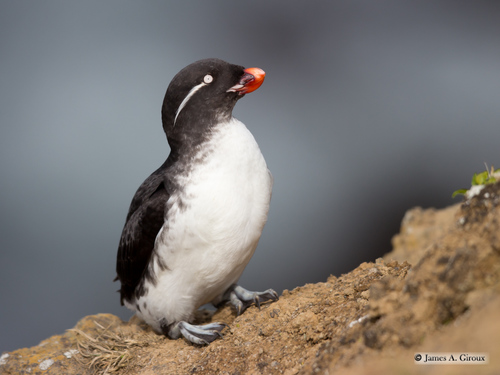
Parakeet Auklet
Aethia psittacula
Meet the 'smiling' seabird of the North Pacific. With its unique upturned bill and elegant white facial plumes, the Parakeet Auklet is a master of the rocky Aleutian cliffs.
Quick Identification
Size
Length: 9–10 in (23–25 cm); Wingspan: 19–20 in (48–51 cm); Weight: 8.8–12 oz (250–340 g)
Colors
Upperparts are sooty black to slate-gray; underparts are bright white. Features a distinctive bright orange-red bill and a thin white plume of feathers extending from behind the eye.
Key Features
- Circular, upturned orange-red bill
- Thin white facial plume behind the eye
- Slate-gray upperparts with white belly
- Stocky, rounded body shape
- Yellowish-white iris
When You’ll See Them
Behavior
The Parakeet Auklet is a social yet somewhat more independent member of the auk family. Unlike their cousins, the Crested or Least Auklets, Parakeet Auklets tend to nest in smaller, more dispersed groups rather than massive, dense colonies. They are exceptionally skilled divers, using their wings to "fly" underwater while hunting for prey in the boreal waters of the North Pacific. During the breeding season, they occupy rocky island cliffs and boulder fields, where they are known for their quiet demeanor compared to the noisy chatter of other seabird colonies.
While they spend most of their lives at sea, they return to land to breed during the spring and summer. They are monogamous and show high site fidelity, often returning to the same rock crevice year after year. Interactions with humans are rare due to their remote island habitats, but they are a favorite for birders visiting the Aleutian or Pribilof Islands. On the water, they are often seen in small groups, resting on the surface between deep foraging dives.
EverydayEarth exclusive
Camera Tips
Capturing the Parakeet Auklet requires a specialized approach since they reside on rugged, wind-swept island cliffs. If you are setting up a camera near a known nesting site, focus on rocky talus slopes or boulder fields where crevices are present. Because these birds are smaller than they appear on screen, position your camera at a low angle, roughly 12 to 24 inches off the ground, to capture their unique profile and facial markings against the rock. Use a heavy-duty tripod or a secure rock mount, as the North Pacific winds can easily tip over standard equipment.
Lighting is your biggest challenge in their foggy, maritime habitats. Set your camera to a higher ISO sensitivity or use a wider aperture if possible to compensate for the frequent overcast conditions. Since Parakeet Auklets are active and move quickly from the sea to their burrows, a high shutter speed or a fast-triggering burst mode is essential. Aim the lens at "landing platforms"—flat, prominent rocks near crevice entrances where the birds often pause to scan for predators before entering their nests.
Salt spray and moisture are the enemies of electronics in auklet territory. Ensure your camera is housed in a weather-sealed, waterproof casing. To avoid lens fogging, use desiccant packets inside the housing. While you shouldn't use food bait in these sensitive ecosystems, these birds are naturally curious about new objects in their environment. Placing a camera near a communal loafing rock (identifiable by white guano staining) is the most effective way to get high-quality close-ups without disturbing their natural nesting behavior.
Similar Species
Species that look similar or are commonly confused with Parakeet Auklet.
Crested Auklet
Has a prominent forward-leaning feather crest on the forehead and lacks the bright white belly of the Parakeet Auklet.
Least Auklet
Much smaller with a shorter, stubbier bill and white speckling on the wings and back.
Whiskered Auklet
Features three distinct white facial plumes and a much smaller, less circular bill.
Frequently Asked Questions
Record Parakeet Auklet at your habitat
Connect a camera to start building your own species record — AI identifies every visitor automatically.