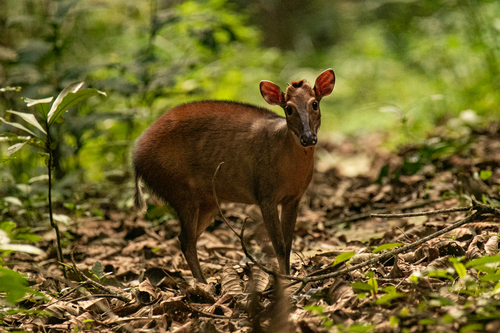
Peters' Duiker
Cephalophorus callipygus
A master of the African rainforest understory, the Peters' Duiker is a vibrant, ginger-hued antelope known for its secretive nature and unique 'beautiful buttocks.' Unlike its nocturnal cousins, this species provides a rare opportunity for daytime wildlife viewing.
Quick Identification
Size
Shoulder height: 45–55 cm (18–22 in); Weight: 15–22 kg (33–48 lbs)
Colors
Rich reddish-brown to tawny coat with a dark brown or blackish dorsal stripe that begins mid-back; buff-colored underbelly
Key Features
- Dark dorsal stripe starting only from the middle of the back and widening at the rump
- Stout, arched body with shorter front legs than hind legs
- Short, straight, spiked horns present in both sexes
- Prominent scent glands visible as slits below the eyes
When You’ll See Them
Behavior
Peters' Duiker is a shy and secretive forest antelope, primarily distinguished by its diurnal activity. Unlike many other duiker species that prefer the cover of night, this species is most active during daylight hours. They are largely solitary animals, although they are occasionally seen in pairs during mating periods or when a mother is accompanied by her calf. They are highly territorial and use the large preorbital glands beneath their eyes to mark twigs and trunks within their home range.
When startled, Peters' Duiker earns its name—derived from the Afrikaans word for 'diver'—by plunging headlong into the nearest dense thicket. They are constantly alert, frequently stopping their foraging to listen for predators such as leopards or large eagles. In the presence of humans, they are naturally elusive, but they can become habituated to a specific area if they feel secure and have a consistent food source like a fruiting tree.
EverydayEarth exclusive
Camera Tips
To successfully capture a Peters' Duiker on camera, placement is the most critical factor. Because these are relatively small, low-slung animals, you must mount your camera much lower than you would for larger deer. Aim for a height of 18 to 24 inches (45–60 cm) off the ground. Ensure the camera is level; an angled shot from a high mounting point often misses the distinctive dorsal stripe that is essential for identification. Look for 'micro-trails'—small, cleared paths through the leaf litter that lead toward large, fruit-bearing trees like Wild Mango or Fig.
Since Peters' Duiker is diurnal, you have a fantastic opportunity to capture high-quality color images. Set your camera to 'Burst Mode' or 'Photo + Video' mode. Because they move with quick, nervous, and often jerky steps, a fast trigger speed (0.4 seconds or less) is necessary to avoid capturing just a blur of red fur. High-resolution video is particularly valuable for this species, as seeing the animal move allows you to confirm the starting point of the dorsal stripe on the back, which is the primary way to tell them apart from the Bay Duiker.
If you are setting up in a private forest or garden area where it is permitted, you can 'bait' the camera site using local fallen fruits. Avoid placing the camera facing East or West; the low-angle sun in the early morning and late afternoon can cause significant lens flare or overexposure on the duiker’s reflective coat. A North-facing orientation in a dappled-light clearing usually provides the most consistent lighting for these beautiful, ginger-colored antelopes.
Similar Species
Species that look similar or are commonly confused with Peters' Duiker.
Bay Duiker
The Bay Duiker has a dark dorsal stripe that starts at the head/neck, whereas the Peters' Duiker's stripe starts mid-back.
Harvey's Duiker
Harvey's Duiker is found primarily in East Africa and lacks the specific widening rump stripe seen on Peters'.
Weyns's Duiker
Weyns's Duiker is a more uniform reddish-brown and lacks the distinct dark dorsal stripe altogether.
Frequently Asked Questions
Record Peters' Duiker at your habitat
Connect a camera to start building your own species record — AI identifies every visitor automatically.