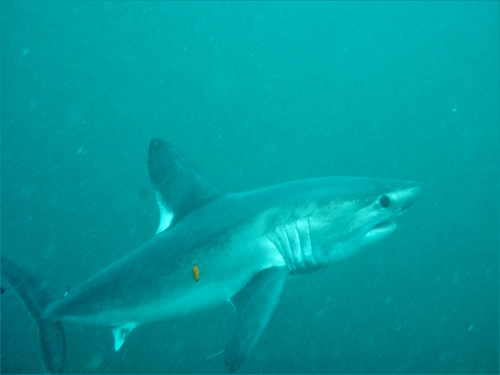
Porbeagle
Lamna nasus
Often called the 'Wolf of the Sea,' the Porbeagle is a stout, powerful predator of cold northern waters. Known for its incredible speed and unique white-tipped fin, it is one of the most fascinating sharks to encounter in the wild.
Quick Identification
Size
Typically 2.5 m (8.2 ft) in length and 135 kg (298 lb); North Atlantic individuals can occasionally reach 3.5 m (11.5 ft).
Colors
Lead-grey to bluish-black upper body with a starkly contrasting white underside; features a unique white patch on the trailing edge of the first dorsal fin.
Key Features
- Distinctive white blotch at the rear base of the first dorsal fin
- Stout, heavy-set body tapering to a pointed snout
- Large, crescent-shaped tail with two pairs of lateral keels
- Three-cusped teeth with small 'side-points'
- Large, dark eyes without a protective nictitating membrane
When You’ll See Them
Behavior
The Porbeagle is an exceptionally active and powerful predator, distinguished by its ability to maintain a body temperature higher than the surrounding water. This endothermic capability allows them to hunt effectively in cold temperate seas where other sharks might become sluggish. They are known for being highly inquisitive and have been observed by divers and researchers engaging in what appears to be play, such as rolling in kelp forests or nudging floating objects.
While they are apex predators, Porbeagles are generally shy toward humans unless provoked. They are known for their seasonal migrations, often moving toward coastal waters in the summer and autumn to follow schools of prey. Unlike many other shark species that are solitary, Porbeagles are sometimes found in small groups or 'packs' while hunting, leading to their nickname, the 'Wolf of the Sea.'
EverydayEarth exclusive
Camera Tips
Capturing a Porbeagle on an AI-powered camera requires a specialized underwater setup, as these are purely marine animals. If you have a coastal property or access to a deep-water dock, the best approach is to use a waterproof 'drop cam' or an action camera mounted in a weighted underwater housing. Secure the camera to a pier piling or a heavy anchor at a depth of 10 to 20 feet. In these depths, the light is usually sufficient for high-quality video without needing heavy artificial lighting, which might spook the shark.
To draw a Porbeagle into the frame, use a scent-based attractant rather than a food reward. A perforated PVC pipe filled with mashed oily fish (like mackerel or sardines) creates a 'chum slick' that will pique the shark's curiosity. Position your camera about 4 to 6 feet away from the scent source, oriented so that the sun is behind the camera. This lighting setup ensures the AI can clearly see the white spot on the dorsal fin, which is the primary ID marker for this species.
Because Porbeagles are fast swimmers, set your camera to its highest possible frame rate (at least 60fps) to avoid motion blur. If your AI software allows for custom triggers, focus on 'large movement' or 'low-contrast shapes.' Since these sharks often approach from below, angling the camera slightly downward or horizontally against a sandy bottom can help the shark's dark grey back stand out against the background. Early autumn is the prime time for this, as the sharks follow baitfish closer to the shoreline.
Similar Species
Species that look similar or are commonly confused with Porbeagle.
Salmon Shark
The Salmon Shark is found only in the North Pacific and has a shorter snout and dark blotches on its belly.
Great White Shark
Much larger as adults, Great Whites lack the white spot on the dorsal fin and have serrated, triangular teeth.
Shortfin Mako
The Mako is more slender with a much longer, more pointed snout and lacks the white dorsal fin blotch.
Frequently Asked Questions
Record Porbeagle at your habitat
Connect a camera to start building your own species record — AI identifies every visitor automatically.