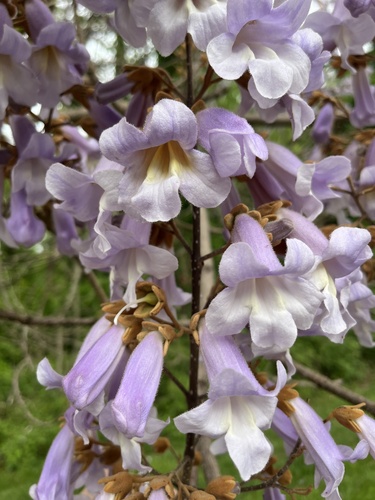
princess tree
Paulownia tomentosa
Boasting massive heart-shaped leaves and stunning clusters of fragrant lavender blooms, the princess tree is a fast-growing marvel of the botanical world. While its beauty is undeniable, its ability to thrive in almost any environment makes it a fascinating, if formidable, backyard inhabitant.
Quick Identification
Size
Height: 10–25 meters (33–82 feet); Canopy spread: 10–15 meters (33–50 feet)
Colors
Pale violet to lavender flowers with yellow interior stripes; bright green velvety leaves; grey-brown bark
Key Features
- Large, upright clusters of bell-shaped purple flowers
- Massive heart-shaped leaves up to 15 inches wide
- Egg-shaped woody seed pods that turn brown and split open
- Hollow or chambered pith in the center of young twigs
When You’ll See Them
Behavior
While admired for its aesthetic beauty and the shade provided by its enormous leaves, it is considered a highly invasive species in many parts of North America and Europe. Its deep taproots and ability to sprout from stumps make it incredibly difficult to eradicate once established. In a backyard setting, it behaves as a 'space-taker,' often outcompeting native shrubs and trees for sunlight and soil nutrients.
EverydayEarth exclusive
Camera Tips
If you are documenting a young sapling, utilize a time-lapse setting. Because this species grows with such prehistoric speed, you can see significant changes in leaf size and height in as little as 48 to 72 hours during the peak of summer. Mount the camera on a separate stake several feet away from the tree to account for its rapid expansion; the massive leaves can quickly grow to cover the lens if the camera is placed too close.
During the autumn and winter months, focus your lens on the unique seed pods. These woody, egg-shaped structures persist on the branches long after the leaves have fallen. They provide excellent visual interest for winter photography and are often visited by small birds looking for seeds or insects hiding in the crevices. Using a macro lens or a close-up setting on your trail camera can reveal the fuzzy, suede-like texture of the next year's flower buds, which are formed in the fall.
For the best lighting, avoid the harsh midday sun, which can cause the large leaves to create deep, dark shadows that obscure detail. Instead, aim for the 'golden hour'—the hour after sunrise or before sunset. The low-angle light brings out the velvety texture of the foliage and the intricate patterns in the grey-brown bark. If your camera has adjustable exposure settings, underexpose slightly to preserve the delicate lavender hues of the flowers, which can easily look 'washed out' in bright light.
Similar Species
Species that look similar or are commonly confused with princess tree.
Northern Catalpa
Catalpa has white flowers with internal spotting and long, bean-like seed pods, unlike the purple flowers and egg-shaped pods of the princess tree.
Southern Catalpa
Very similar to the Northern variety but smaller; its leaves emit a pungent odor when crushed, which the princess tree does not.
Velvetleaf
This is a smaller herbaceous plant, not a tree, though its large, soft, heart-shaped leaves can resemble a young princess tree sapling.
Frequently Asked Questions
Record princess tree at your habitat
Connect a camera to start building your own species record — AI identifies every visitor automatically.