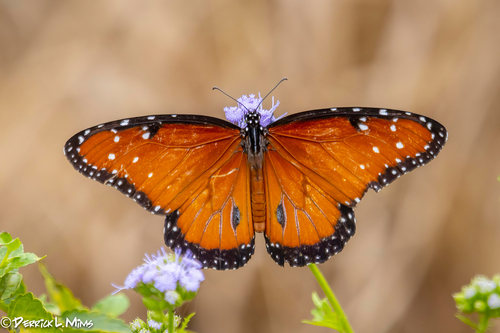
Queen
Danaus gilippus
Meet the Queen, a regal mahogany-winged beauty that thrives in the sun-drenched gardens of the Americas. While it shares a family tree with the Monarch, this resilient butterfly is a master of the desert and the subtropics.
Quick Identification
Size
Wingspan of 80–85 mm (3.1–3.3 inches)
Colors
Deep mahogany or orange-brown wings with black borders and white spots; males have a black scent patch on the hindwings
Key Features
- Rich mahogany-brown color without heavy black veining on upper wings
- Small white spots scattered across the forewings
- Black wing margins containing two rows of small white dots
- Male has a distinct black scent patch on each dorsal hindwing
When You’ll See Them
Geographic range
Where Does the Queen Live?
The Queen butterfly is native to the Americas, maintaining a vast presence from the southern United States through Central America and into much of South America. In North America, they are core residents of the 'Sun Belt,' ranging from Florida and the Gulf Coast through Texas and into the arid Southwest and California. While they occasionally stray as far north as the Midwest or even Southern Canada during peak summer, they are most consistently found in tropical and subtropical regions where milkweed stays green year-round.
Basemap © OpenStreetMap contributors
Behavior
The Queen is a leisurely but powerful flyer, often seen gliding through sunny meadows and gardens with a sense of confidence. This lack of fear is a defense mechanism; as caterpillars, they feed on milkweed plants, sequestering cardenolide toxins that make the adults unpalatable and even dangerous to predators like birds. They are often observed in 'puddling' groups, where males especially congregate on damp soil to extract essential minerals and salts.
Unlike their famous relative, the Monarch, the Queen does not undergo a massive, multi-generational migration across continents. Instead, they are more localized, though they will shift their range seasonally to follow the availability of host plants or to escape freezing temperatures. They are highly social at nectar sources, often sharing a single cluster of flowers with several other butterflies without aggression.
EverydayEarth exclusive
Camera Tips
To capture the Queen butterfly on an AI-powered camera, you must focus on 'landing zones' rather than the open air. Position your camera on a tripod or mount it low to the ground, aiming directly at nectar-rich flowers like Milkweed, Lantana, or Mistflower. Because butterflies are cold-blooded, ensure your camera is pointed toward a south-facing, sunny spot; Queens are most likely to visit blooms that are bathed in direct sunlight for at least 6 hours a day.
Standard trail cameras can struggle with small insects due to their PIR (Passive Infrared) sensors looking for larger heat signatures. To overcome this, use a camera with a 'Time Lapse' mode or a high-sensitivity setting. Set the camera to trigger every 30-60 seconds during the peak hours of 11 AM to 2 PM. If your camera allows for macro photography or has a close-focus lens, place it within 18 inches of the flower cluster to capture the fine details of the scent patches on the male's wings.
You can attract Queens specifically to your camera's field of view by creating a 'puddling station.' Simply bury a shallow dish in the ground, fill it with a mix of sand and garden soil, and keep it damp with a little bit of salt-enriched water. Queens will often land here to sip minerals, providing a stable, ground-level subject for your camera. Avoid using high-speed video unless you have plenty of light, as the high shutter speeds required to freeze their wings can lead to dark images in shaded garden corners.
Similar Species
Species that look similar or are commonly confused with Queen.
Monarch
The Monarch is a lighter bright orange and has prominent black veins across the entire upper wing surface, which the Queen lacks.
Soldier
The Soldier butterfly has more distinct white mirroring/veining on its underwings and is generally found in more tropical coastal areas.
Viceroy
The Viceroy has a distinctive horizontal black line crossing the veins of the hindwing, which neither the Queen nor the Monarch possesses.
Frequently Asked Questions
Record Queen at your habitat
Connect a camera to start building your own species record — AI identifies every visitor automatically.