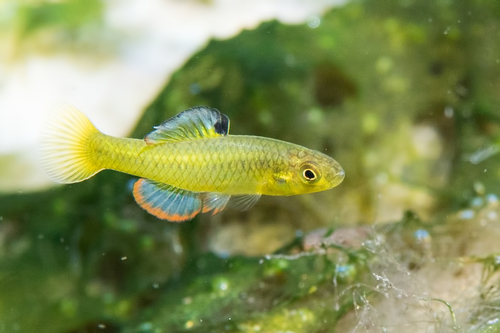
Rainwater Killifish
Lucania parva
A shimmering micro-predator of the shallows, the Rainwater Killifish is a master of adaptation, equally at home in a salty marsh or a backyard freshwater pond.
Quick Identification
Size
25–62 mm (1–2.5 inches) in length; weighing less than 5 grams (0.2 oz)
Colors
Translucent silvery-gray body; scales have dark edges creating a diamond pattern. Males develop yellow to orange-tinted fins during breeding, often with a dark spot on the dorsal fin.
Key Features
- Distinct diamond-shaped scale pattern
- Deep, stocky body for a small fish
- Upturned, 'pouty' mouth for surface feeding
- Translucent body with yellow flashes on fins
When You’ll See Them
Geographic range
Where Does the Rainwater Killifish Live?
Native to the North American coastline, the Rainwater Killifish occupies a vast stretch from Cape Cod, Massachusetts, southward through Florida and along the Gulf of Mexico to Tampico, Mexico. While it is primarily a coastal species, it has been successfully introduced to several inland regions in the Western United States, including California, Nevada, and Utah. These populations often take hold in desert springs and man-made reservoirs where they can tolerate the high mineral content of the water.
Basemap © OpenStreetMap contributors
Behavior
Rainwater Killifish are energetic, schooling fish known for their incredible physiological resilience. They are 'euryhaline,' meaning they can thrive in environments ranging from completely fresh water to hypersaline lagoons that are saltier than the open ocean. In the wild, they are often seen hovering in the top few inches of the water column, darting between the stalks of aquatic vegetation to avoid predators like herons or larger fish.
Socially, these fish are peaceful but highly active. During the breeding season, males become somewhat territorial, displaying their darkened fins to attract mates and ward off rivals. Because they are voracious consumers of mosquito larvae, they play a vital role in wetland ecosystems and are occasionally used by humans for natural pest management in backyard ponds and ornamental water features.
EverydayEarth exclusive
Camera Tips
Capturing the Rainwater Killifish requires a specialized underwater approach. If you have a backyard pond or access to a creek, place a waterproof action camera or a dedicated underwater trail camera in the shallows, no deeper than 10 inches. Aim the lens toward a patch of submerged aquatic plants like Hornwort or Coontail, as these fish rarely venture far from the safety of dense cover. A side-on angle is best to capture the 'diamond' pattern of their scales.
To encourage a school to linger in front of the lens, use a small mesh bait bag filled with frozen brine shrimp or bloodworms. Secure the bag to a stake or a rock directly in the camera's focal zone. The scent will draw them in, and their frantic feeding behavior provides excellent high-action footage. Be sure to clear any floating debris or excess algae from the lens area to ensure the AI detection can lock onto their small, fast-moving shapes.
Natural lighting is the most important factor for success. Position your setup in a spot that receives direct sunlight between 10 AM and 2 PM. The sun's rays will penetrate the water and reflect off the fish's silver bodies, making them pop against the green or brown background of the pond. Use a high frame rate setting (at least 60fps) if your camera allows, as this will help you see the intricate fin displays and darting movements that are often a blur at standard speeds.
Similar Species
Species that look similar or are commonly confused with Rainwater Killifish.
Eastern Mosquitofish
The Mosquitofish is more slender and lacks the dark-edged, diamond-shaped scales of the Rainwater Killifish.
Sheepshead Minnow
Sheepshead Minnows are much wider and more aggressive, with prominent dark vertical bands along their sides.
Bluefin Killifish
Bluefin Killifish feature a dark horizontal stripe and brilliant blue or red fins, whereas Rainwater Killifish are mostly silver and yellow.
Frequently Asked Questions
Record Rainwater Killifish at your habitat
Connect a camera to start building your own species record — AI identifies every visitor automatically.