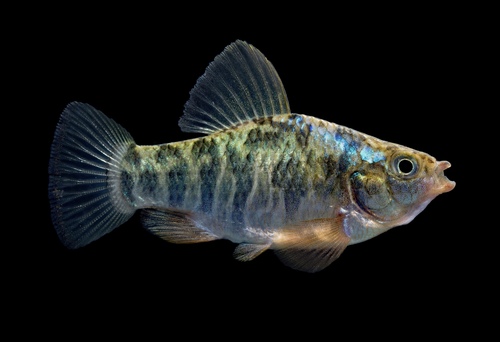
Sheepshead Minnow
Cyprinodon variegatus
A pint-sized powerhouse of the salt marsh, the Sheepshead Minnow is famous for its stunning iridescent blue breeding colors and its unmatched ability to thrive in extreme coastal environments.
Quick Identification
Size
3 to 7.5 cm (1 to 3 inches) in length; weights typically under 10 grams
Colors
Olive, gray, or silvery sides with 7-8 dark vertical bars; breeding males develop a brilliant iridescent blue 'saddle' on their backs and orange-edged fins
Key Features
- Deep, diamond-shaped body profile
- Dark vertical bars on the sides
- Small, upturned mouth with tricuspid teeth
- Iridescent blue nape in breeding males
When You’ll See Them
Geographic range
Where Does the Sheepshead Minnow Live?
The Sheepshead Minnow is a coastal specialist native to the eastern shores of North and Central America. Its core range extends from the temperate waters of Cape Cod in the United States, south through the Florida peninsula, and along the entire Gulf of Mexico coastline. Beyond the U.S., it is commonly found in the Bahamas, the Greater Antilles, and along the eastern coast of Mexico down to the Yucatán Peninsula. While primarily a saltwater and brackish species, some isolated populations have been introduced to inland saline waters in West Texas and New Mexico.
Basemap © OpenStreetMap contributors
Behavior
The Sheepshead Minnow is a resilient 'extremophile' of the salt marsh, capable of surviving in water temperatures and salinity levels that would be fatal to most other fish. These pupfish are highly active during the day, darting through shallow seagrass beds and hovering over muddy bottoms. They are social creatures, often found in loose schools, where they spend their time foraging or evading larger predators like herons and predatory fish.
During the breeding season, the social dynamic shifts as males become intensely territorial. A dominant male will claim a small patch of the substrate—sometimes just a few inches wide—and defend it aggressively against any intruding males. He will perform vibrant 'looping' displays to attract females, showing off his metallic blue coloring. Outside of breeding, they are generally peaceful but busy, playing a vital role in the ecosystem by controlling mosquito populations and serving as a food source for coastal birds.
EverydayEarth exclusive
Camera Tips
Capturing the Sheepshead Minnow requires a focus on the shallows. Because these fish thrive in water only a few inches deep, you don't need deep-sea equipment. An underwater action camera or a submersible trail camera should be placed in tidal pools or at the edge of a salt marsh at low tide. Position the lens about 4-6 inches from the bottom, angled slightly upward toward the surface to capture the shimmer of the fish's scales in the sunlight.
To ensure the AI identifies the species clearly, try to place your camera over a patch of light-colored sand or a flat white shell. This provides a high-contrast background that makes the dark vertical bars and the male's blue 'saddle' stand out. Avoid areas with heavy silt or mud that might be stirred up by the tide, as murky water will hinder the camera's ability to focus. If the water is naturally tea-colored or dark, aim for mid-day filming when the sun is directly overhead to provide maximum illumination.
While you can use a small mesh bag of crushed bait to draw them in, it is often more effective to look for natural 'arenas.' During the spring and summer, look for small cleared circles in the sand—these are the nesting sites of territorial males. Placing a camera near one of these pits will allow you to record the fascinating territorial dances and spawning behavior that make this species so unique. Be mindful of the tides; secure your camera mount to a stake or weighted base so it doesn't wash away as the water levels rise.
Similar Species
Species that look similar or are commonly confused with Sheepshead Minnow.
Mummichog
Much more elongated, cigar-shaped body compared to the deep, diamond profile of the Sheepshead Minnow.
Banded Killifish
Has a more slender body and prefers fresher water, with more numerous and thinner vertical bands.
Sailfin Molly
Males have a massive, sail-like dorsal fin and lack the distinct dark vertical bars seen on the Sheepshead Minnow.
Frequently Asked Questions
Record Sheepshead Minnow at your habitat
Connect a camera to start building your own species record — AI identifies every visitor automatically.