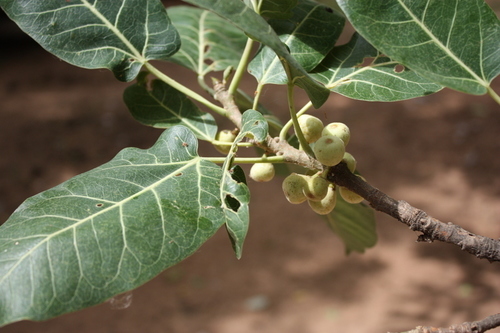
red-leaved fig
Ficus ingens
A master of adaptation, the red-leaved fig transforms from a rugged rock-clinger into a towering giant. Its signature copper-colored new growth and sweet fruit make it a magnetic hub for backyard biodiversity.
Quick Identification
Size
Height ranges from a 1-2m (3-6ft) stunted shrub to a 15m (50ft) spreading tree; canopy can exceed 30m (100ft) in width.
Colors
Smooth pale grey bark; mature leaves are dark green; new spring growth is a vibrant copper-red or bronze.
Key Features
- Brilliant copper-red young foliage in spring
- Smooth, pale grey to creamy-white bark
- Small, stalkless figs (approx. 1cm) that turn from white to pinkish-purple
- Heart-shaped leaf bases with yellowish veins
When You’ll See Them
Behavior
The red-leaved fig is a master of adaptation, famously known as a 'rock-splitter.' In harsh, rocky environments, it often grows as a stunted, lithophytic shrub, sending powerful roots into crevices to find water. However, when situated in deeper soil or warmer lowlands, it can expand into a massive, wide-reaching tree with a thick trunk and a dense, cooling canopy.
Ecologically, this species is a keystone plant. Like all figs, it has a specialized relationship with Agaonid wasps, which are the only insects capable of pollinating its flowers hidden inside the fruit. This tree acts as a bustling social hub for wildlife; when in fruit, it becomes a noisy, high-traffic area for birds, monkeys, and fruit bats, making it an essential component of its local ecosystem.
Historically, the tree has been used by humans for both shelter and medicine. Its extensive canopy provided shade for entire villages in the past, and its latex and bark are still used in traditional practices across its African range. It is generally slow-growing but incredibly long-lived once established.
EverydayEarth exclusive
Camera Tips
Capturing the beauty of a red-leaved fig involves two strategies: documenting its stunning seasonal color changes and monitoring the incredible diversity of wildlife it attracts. To capture the famous 'red flush,' set your camera to take daily time-lapse photos during the transition from winter to spring. The copper-bronze color of the new leaves is highly reflective, so ensure your camera is positioned with the sun behind it to prevent the pale bark from 'washing out' the image. If your camera allows for white balance adjustment, 'cloudy' or 'daylight' settings will help pop those warm red tones.
For wildlife monitoring, the best placement for a trail camera is 5-8 feet off the ground, angled slightly downward toward a main fruiting branch. Because Ficus ingens produces small, sessile (stalkless) figs directly on the branches, animals will often linger in one spot to feed. Position your camera about 10 feet away from a cluster of ripening figs to capture crisp video of barbets, starlings, and monkeys. If you are in a suburban area, place the camera near the base of the trunk where fallen figs attract terrestrial visitors like porcupines or small antelope during the night.
During the peak fruiting season, increase your camera's trigger sensitivity and reduce the 're-trigger' delay. The activity around a fruiting fig is frantic, and a short delay ensures you don't miss the interaction between different species vying for the best fruit. If you are using an AI-powered camera like those from EverydayEarth, ensure the lens is clean of the sticky white latex the tree produces if a branch is bumped or nicked, as this can cloud your sensors.
Lastly, consider the 'Moffat' effect—the tree's massive size. If you have a wide-angle lens, place a second camera further back (20-30 feet) to capture the overall silhouette of the tree. This provides a beautiful context for the close-up wildlife shots and highlights the unique, gnarled structure of the pale grey branches against the sky.
Similar Species
Species that look similar or are commonly confused with red-leaved fig.
Wonderboom Fig
The Wonderboom (Ficus salicifolia) has narrower, more willow-like leaves and smaller, more numerous figs.
Common Wild Fig
Ficus thonningii has more yellowish-green new growth and a much more aggressive, 'strangler' growth habit compared to the rock-loving Ficus ingens.
Cape Fig
Ficus sur has much larger, fleshier fruit that grows in heavy clusters on the lower trunk rather than on the branches.
Frequently Asked Questions
Record red-leaved fig at your habitat
Connect a camera to start building your own species record — AI identifies every visitor automatically.