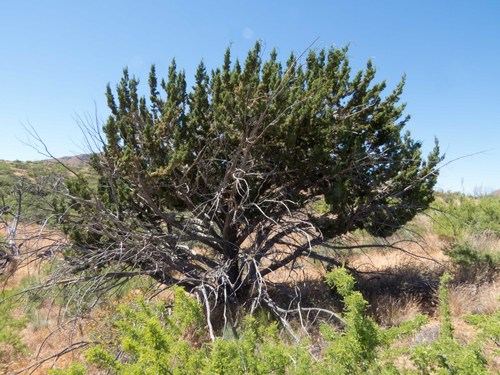
redberry juniper
Juniperus arizonica
A hardy icon of the Sonoran Desert, the redberry juniper is famous for its vibrant copper-red fruit and shredding bark. It serves as a bustling hub for desert birds and mammals seeking food and shelter in the arid Southwest.
Quick Identification
Size
A shrub or small tree typically reaching 3–8 m (10–26 ft) in height with a broad, multi-stemmed crown.
Colors
Dull yellow-green foliage; gray-brown bark that shreds in long strips; seed cones are a distinctive copper-red to orange-red.
Key Features
- Copper-red to reddish-orange fleshy seed cones (berries)
- Gray bark that peels in thin, longitudinal strips
- Dull yellow-green, scale-like leaves with small glands
- Low-branching or multi-stemmed growth habit
When You’ll See Them
Geographic range
Where Does the redberry juniper Live?
The redberry juniper is a native fixture of the North American Southwest, primarily centered in the rugged landscapes of the Sonoran Desert. Its core range encompasses the state of Arizona and extends into southwestern New Mexico, while moving southward across the international border into the Mexican states of Sonora and Chihuahua. This resilient conifer is most commonly found clinging to limestone hillsides and desert foothills where other trees struggle to take hold.
Basemap © OpenStreetMap contributors
Behavior
The redberry juniper is a slow-growing, long-lived evergreen that plays a vital role in the arid ecosystems of the Southwest. Unlike many other conifers, it is exceptionally drought-tolerant, utilizing a deep taproot system to access moisture in rocky, limestone-heavy soils. During the late summer and fall, the tree produces a prolific crop of fleshy, berry-like cones that serve as a critical food source for desert wildlife when other resources are scarce.
As a foundational species, it provides essential thermal cover for small mammals and nesting sites for various desert bird species. While it doesn't 'move' in the traditional sense, its seasonal cycles are highly predictable; it releases pollen in the late winter, which can be seen as yellow clouds on windy days, and matures its distinctive red fruit over the course of a year. It interacts with humans primarily as a landscape plant in xeric gardens and as a source of pollen for allergy sufferers.
EverydayEarth exclusive
Camera Tips
To capture the best images of a redberry juniper, focus your camera on a branch heavily laden with its namesake red fruit. These 'berries' are a magnet for wildlife, particularly during the late autumn and winter months. Position your camera about 3 to 5 feet off the ground, angled slightly downward if the tree is a shrub, or at eye level with a fruiting branch. Using a macro-capable trail camera can help capture the intricate details of the scale-like leaves and the waxy coating on the berries.
Because the berries are the primary draw, you don't need artificial lures. Instead, look for a tree that shows signs of animal activity, such as bird droppings or tracks from small mammals like gray foxes or rock squirrels at the base. These animals frequently visit the tree to forage. Setting your camera to 'Burst Mode' is highly recommended; birds like the Phainopepla or Cedar Waxwing often hover or move quickly between branches, and a single shot might miss the action.
Lighting in the desert can be harsh, often washing out the subtle copper tones of the juniper berries. If possible, place your camera so the tree is back-lit during the 'golden hour' of late afternoon, which will make the red berries glow against the dull green foliage. If your camera allows for sensitivity adjustments, set the trigger to high to catch the quick movements of songbirds, but be mindful of wind-blown branches which can cause false triggers in this species' dense canopy.
Similar Species
Species that look similar or are commonly confused with redberry juniper.
One-seed Juniper
Has smaller, often blue-black berries and leaves that are usually more yellow-green than the Arizona variety.
Utah Juniper
Usually grows into a larger, more rounded tree with thicker branches and larger, dry, fibrous berries that stay brownish-blue.
Alligator Juniper
Easily distinguished by its unique bark which breaks into thick, square plates resembling alligator skin.
Frequently Asked Questions
Record redberry juniper at your habitat
Connect a camera to start building your own species record — AI identifies every visitor automatically.