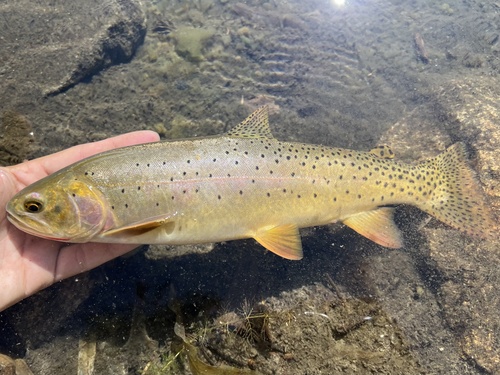
Rocky Mountain Cutthroat Trout
Oncorhynchus virginalis
The crown jewel of the Rockies, this native trout is as beautiful as the mountain streams it calls home. With its signature crimson jaw markings, it is a living symbol of the pristine American West.
Quick Identification
Size
6-16 inches (15-40 cm) in streams; can reach 20+ inches (50 cm) in lakes. Weight typically 0.5-2 lbs (0.2-0.9 kg).
Colors
Olive-green to yellowish-brown body with small, dark spots concentrated toward the tail; signature bright red or orange 'slash' markings under the lower jaw; rosy hues on the gill covers.
Key Features
- Distinctive red/orange streaks on the underside of the jaw
- Small dark spots more numerous near the tail than the head
- Basibranchial teeth (small teeth at the base of the tongue)
- Yellowish-gold to silvery-white belly
When You’ll See Them
Behavior
Rocky Mountain Cutthroat Trout are highly sensitive indicators of water quality, thriving only in the coldest, cleanest mountain streams and alpine lakes. They are known for their opportunistic feeding habits, often positioning themselves in the 'seam' of a river where fast-moving water meets a slow pool to wait for food to drift by. Unlike some trout species that are skittish and hide deep under banks, Cutthroats are relatively curious and can often be seen hovering mid-water in clear pools.
During the spring and early summer, these trout exhibit fascinating migratory behavior as they move upstream to gravelly headwaters for spawning. This is a high-energy period where they are most visible, often jumping over small obstacles or congregating in shallow riffles. In the winter, they move to deeper, slower-moving holes to conserve energy in the frigid water.
While they are solitary by nature when it comes to feeding territories, they are not aggressive toward humans. However, they are easily stressed by high water temperatures and poor handling, making them a species that requires careful observation rather than direct interaction.
EverydayEarth exclusive
Camera Tips
Capturing the Rocky Mountain Cutthroat Trout requires a specialized approach, as standard trail cameras aren't designed for underwater use. We recommend using an action camera (like a GoPro) or a dedicated underwater trail camera with a weighted mount. Place your camera in 'slack water'—the area just behind a large boulder or at the edge of a deep pool—where the water is clear and the fish can hold their position without fighting the current.
Lighting is your biggest challenge under the surface. For the best results, position the camera to face north or south to avoid the direct glare of the sun through the water's surface, which can wash out the fish's colors. Ideally, find a spot where the stream is shaded by overhanging trees or a high bank; this diffused light makes the red throat slashes and dark spots pop in your footage. Set your camera to a high frame rate (60fps or higher) to capture the fluid, flickering movements of the trout as they strike at insects.
If you are setting up a semi-permanent station, use a tether to secure your camera to a heavy rock or a sturdy root on the bank to prevent it from being swept away during a sudden mountain rainstorm. In backyard streams, you can 'lure' them into the camera's field of view by disturbing a few rocks upstream to kick up aquatic larvae, though natural observation usually yields the most authentic behavior. Late summer is the best time for clarity, as spring runoff can make the water too murky for good video.
Similar Species
Species that look similar or are commonly confused with Rocky Mountain Cutthroat Trout.
Rainbow Trout
Lacks the red jaw slash; features a prominent pink/red lateral stripe and more uniform spotting across the head and body.
Brown Trout
Has larger, haloed spots (often orange or red) and a more golden-brown overall body color compared to the Cutthroat's silvery-olive.
Brook Trout
Actually a char; features light spots on a dark background and white leading edges on its lower fins.
Frequently Asked Questions
Record Rocky Mountain Cutthroat Trout at your habitat
Connect a camera to start building your own species record — AI identifies every visitor automatically.