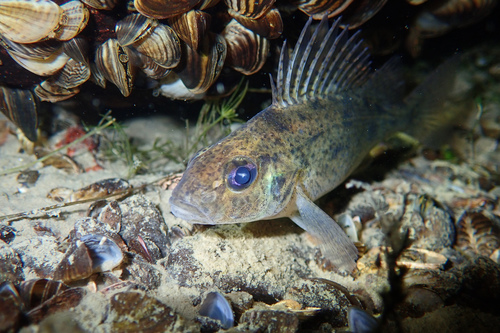
Ruffe
Gymnocephalus cernua
A small but incredibly resilient bottom-dweller, the Ruffe is a master of low-light survival. While a vital part of Eurasian ecosystems, its rapid reproduction and prickly defenses have made it a formidable invader in North American waters.
Quick Identification
Size
Typically 10-15 cm (4-6 inches) long, but can reach up to 25 cm (10 inches); weighs between 20-100 grams (0.7-3.5 oz).
Colors
Olive-brown to golden-brown upper body with dark, irregular speckling; yellowish-white belly and dark spots on the dorsal and tail fins.
Key Features
- Single continuous dorsal fin where spiny and soft rays are joined
- Large, glassy eyes with a reflective layer for low-light vision
- Downturned, protractile mouth used for vacuuming the substrate
- Lack of scales on the head, revealing prominent sensory pits
- Sharp, prickly spines on the dorsal and anal fins
When You’ll See Them
Geographic range
Where Does the Ruffe Live?
The Ruffe is native to the temperate fresh and brackish waters of Eurasia, with a natural range extending from the United Kingdom across central and eastern Europe into the Caspian Sea and Siberia. In the late 20th century, it was accidentally introduced to North America via ballast water, where it established a significant invasive presence in the Great Lakes, particularly Lake Superior and Lake Michigan. These adaptable fish are most commonly found in lowland regions where water remains cool but not freezing.
Basemap © OpenStreetMap contributors
Behavior
The Ruffe is a hardy and opportunistic bottom-dweller known for its ability to thrive in conditions that many other fish find difficult. They are primarily crepuscular, meaning they are most active during the dim light of dawn and dusk, though they may feed throughout the day in deeper, turbid waters. This species is highly gregarious, often forming large, dense schools that can outcompete native fish for both food and space.
A key to their survival is their advanced lateral line system and reflective eyes, which allow them to detect movement and find prey in near-total darkness or muddy water. While they are generally wary of large predators, they are surprisingly bold when foraging. In regions where they have been introduced, they are often viewed as a nuisance by human anglers because they aggressively take bait meant for more desirable species and are difficult to handle due to their sharp, spiny fins.
EverydayEarth exclusive
Camera Tips
Capturing the Ruffe on camera requires a specialized underwater setup, such as a submerged action camera or a dedicated underwater trail camera. For the best results, place your camera on a flat, silty or sandy bottom in water between 2 and 5 meters deep. Because these fish are sensitive to light but active in the dark, use a camera with high-quality Infrared (IR) LEDs to capture crisp black-and-white footage at night without startling the school.
To keep a school of Ruffe in the frame, use a weighted mesh bait bag. Stuff the bag with chopped nightcrawlers, fish roe, or bloodworms and anchor it directly in front of the lens. The scent will draw them in from downstream. Since they are bottom-dwellers, position your camera horizontally—about 5-10 centimeters off the substrate—rather than looking down from above. This angle provides the best view of their identifying dorsal fins and large eyes.
Turbidity can be a challenge when filming Ruffe, as they love murky water. Try to deploy your camera after a period of calm weather when the sediment has settled. If you are using a camera in a backyard pond or a clear stream, look for 'slack water' areas behind large rocks or submerged logs, as Ruffe prefer to congregate where they don't have to fight a strong current. During the spring, focus your efforts on shallower shorelines where they move to spawn.
Similar Species
Species that look similar or are commonly confused with Ruffe.
Yellow Perch
Has two separate dorsal fins and vertical dark bars on its sides, unlike the Ruffe's single fin and spotted pattern.
Walleye
Grows much larger and has a distinct white tip on the lower lobe of its tail fin.
Round Goby
Lacks the high, spiny dorsal fin of the Ruffe and has fused pelvic fins that act like a suction cup.
Frequently Asked Questions
Record Ruffe at your habitat
Connect a camera to start building your own species record — AI identifies every visitor automatically.