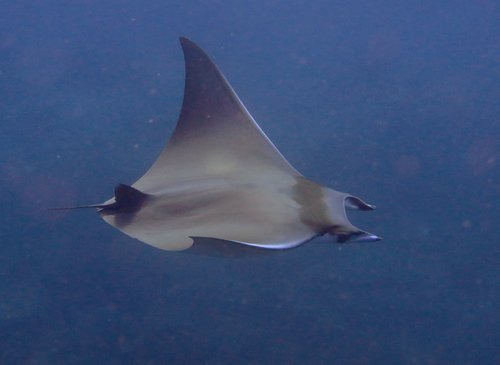
Shorthorned Pygmy Devil Ray
Mobula kuhlii
The Shorthorned Pygmy Devil Ray is a miniature marvel of the tropical oceans, famous for its acrobatic leaps and gentle nature. Though small in stature, this 'pygmy' ray brings a sense of wonder to any coastal backyard with its graceful, wing-like movements.
Quick Identification
Size
Disc width typically 90–120 cm (35–47 inches); weight approximately 20–30 kg (44–66 lbs).
Colors
Dark brownish-grey to black dorsal (top) side; white ventral (bottom) side with faint greyish markings near the fin margins.
Key Features
- Short and blunt cephalic fins or 'horns'
- Pygmy-sized disc with distinctively pointed wingtips
- Absence of a stinging spine on the tail
- Small, subterminal mouth designed for filter feeding
When You’ll See Them
Behavior
The Shorthorned Pygmy Devil Ray is a social and highly mobile species known for its graceful underwater 'flight.' Unlike their larger manta cousins, these rays are quite shy and tend to move in small schools or pairs. They spend a significant portion of their day cruising coastal waters and reef edges, using their cephalic fins to funnel plankton-rich water into their mouths. Despite their 'devil' moniker—earned from the horn-like fins on their heads—they are entirely harmless to humans and lack a defensive tail stinger.
One of the most thrilling behaviors of the Shorthorned Pygmy Devil Ray is its propensity for breaching. They are known to leap entirely out of the water, performing acrobatic flips before landing with a loud slap. Researchers believe this behavior could be a form of communication, a method to remove parasites, or simply a part of social play. In the presence of humans, they are generally elusive, preferring to maintain a safe distance unless they become accustomed to a specific quiet cove or dock area.
EverydayEarth exclusive
Camera Tips
To capture the Shorthorned Pygmy Devil Ray, you will need to adapt your trail camera setup for a marine environment. If you live on a coastal property with a private dock or pier, the best approach is to use an underwater-rated action camera or a specialized submersible trail camera. Mount the camera roughly 1 to 2 meters below the low-tide line, angled slightly upward toward the surface. This 'low-angle' positioning allows the AI to capture the distinct silhouette of the ray against the sunlight, which is often the easiest way to identify the species by its wing shape and cephalic fins.
Lighting is your biggest challenge underwater. While the rays are diurnal, they often feed in the early morning when the water is calmer but light is low. If your camera supports it, use a wide-angle lens to account for the ray's wide wingspan and erratic swimming patterns. Avoid using high-intensity artificial white lights, as these can spook the rays or attract swarms of baitfish that will obscure your view. Instead, rely on natural ambient light or subtle red-spectrum LEDs if your camera is equipped with them for night observations.
Since these rays follow plankton blooms, timing is everything. They are most likely to pass by your camera during an incoming tide when nutrient-rich water is pushed toward the shore. If you are using an AI-powered camera like those supported by EverydayEarth, set your motion sensitivity to 'High' to account for the fluid, gliding motion of the ray, which can sometimes be missed by sensors calibrated for jerky land animals. Positioning your camera near a structural 'pinch point,' such as the end of a jetty or a gap in a reef, will significantly increase your chances of a close-up encounter.
Similar Species
Species that look similar or are commonly confused with Shorthorned Pygmy Devil Ray.
Longhorned Pygmy Devil Ray
The Longhorned variety has significantly longer, more flexible cephalic fins and a slightly different dorsal coloration.
Reef Manta Ray
Much larger than the pygmy ray, with a mouth located at the very front of the head rather than tucked slightly underneath.
Spinetail Devil Ray
Features a distinct spine at the base of the tail and grows to nearly double the size of the Shorthorned Pygmy.
Frequently Asked Questions
Record Shorthorned Pygmy Devil Ray at your habitat
Connect a camera to start building your own species record — AI identifies every visitor automatically.