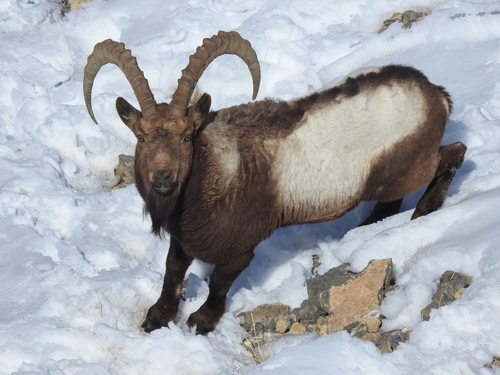
Siberian Ibex
Capra sibirica
The largest and most widely distributed of all wild goats, the Siberian Ibex is the true king of the Central Asian peaks. Known for their staggering climbing ability and massive, scimitar-shaped horns, they are a crown jewel for any high-altitude wildlife monitor.
Quick Identification
Size
Body length 130–165 cm (51–65 in); Weight 35–130 kg (77–287 lb)
Colors
Tan to dark brown with a darker dorsal stripe; males develop a lighter 'saddle' patch and dark beards in winter
Key Features
- Massive scimitar-shaped horns with prominent ridges
- Long goatee-like beard on males
- Stocky, muscular build with short, sturdy legs
- Light brown coat that thickens and darkens during winter
When You’ll See Them
Geographic range
Where Does the Siberian Ibex Live?
The Siberian Ibex claims the most expansive territory of any wild goat species, primarily occupying the rugged mountain heart of Central Asia. Their native range stretches from the Altai and Tian Shan mountains in Russia, Mongolia, and China, extending southward through the high-altitude regions of Kazakhstan, Kyrgyzstan, Tajikistan, and Uzbekistan. They are also found in the northern reaches of Afghanistan, Pakistan, and the Himalayan regions of India, where they thrive in some of the most inaccessible terrain on Earth.
Basemap © OpenStreetMap contributors
Behavior
Siberian Ibex are highly social animals, typically found in herds that can range from a few individuals to over fifty. Outside of the breeding season, males and females often live in separate groups, with bachelor herds inhabiting higher, more rugged terrain while females and juveniles stay in areas with easier access to forage. They are master mountaineers, capable of navigating near-vertical rock faces to escape predators like wolves, snow leopards, and lynx.
These goats are primarily diurnal, though they shift their activity to the cooler dawn and dusk hours during the heat of the summer. They spend a significant portion of their day grazing on mountain slopes and retreating to inaccessible rocky crags to rest and ruminate. While generally wary of humans, populations in protected areas can become somewhat habituated, though they always maintain a safe distance near steep escape routes.
EverydayEarth exclusive
Camera Tips
To capture the Siberian Ibex on a trail camera, you must think like a mountaineer. These animals rely heavily on 'escape terrain'—the steep, broken rock faces where they feel safest from predators. Positioning your camera on narrow ridgelines, mountain passes (saddles), or at the base of prominent rock chimneys will yield the best results. Because males can stand nearly 40 inches at the shoulder and carry horns that reach 5 feet in length, mount your camera at least 3.5 to 4 feet off the ground and angle it slightly upward to ensure the entire animal stays in the frame.
In the dry, high-altitude environments they inhabit, water and minerals are the ultimate attractants. Natural mineral licks (solonetz) or high-mountain springs are high-traffic zones that will draw every ibex in the vicinity. If you are placing a camera in these areas, use a high-endurance strap and a security box; the harsh mountain winds and the curious, head-butting nature of young males can easily displace or damage unprotected equipment. Set your camera to a multi-shot burst mode with a fast trigger speed, as these goats move with surprising agility and speed across rocky gaps.
The most dramatic footage is often captured during the winter months. Between November and January, the rut brings males down to slightly lower elevations to compete for females. This is the best time to record the iconic clashing of horns. During this season, ensure your camera has fresh lithium batteries, as standard alkaline batteries will fail in the sub-zero temperatures typical of ibex habitat. Use a 30-second video setting to capture the social dynamics and vocalizations of the herd, which are much more frequent during the breeding season.
Similar Species
Species that look similar or are commonly confused with Siberian Ibex.
Markhor
Markhor have tightly spiraled, corkscrew-like horns and a much longer, flowing mane on the neck and chest.
Alpine Ibex
Generally smaller than the Siberian Ibex and found exclusively in the European Alps.
Himalayan Tahr
Tahr have much shorter, smoother horns and a very thick, woolly reddish-brown coat with no beard.
Frequently Asked Questions
Record Siberian Ibex at your habitat
Connect a camera to start building your own species record — AI identifies every visitor automatically.