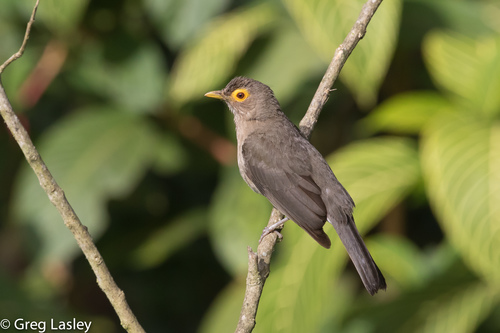
Spectacled Thrush
Turdus nudigenis
With its striking orange-yellow 'spectacles' and a song that rivals the finest musicians, the Spectacled Thrush is a charismatic star of tropical backyards. A bold and curious neighbor, it brings both color and melody to any garden it visits.
Quick Identification
Size
23–24 cm (9–9.5 inches) in length; wingspan of approximately 34–38 cm (13.5–15 inches); weight ranges from 55–75 grams (1.9–2.6 oz).
Colors
Uniform olive-brown upperparts with a slightly paler, buff-colored breast and belly. The throat is whitish with subtle dark streaks. Both sexes look identical, featuring the namesake bright orange-yellow bare skin around the eyes.
Key Features
- Large, fleshy orange-yellow rings around the eyes
- Uniform olive-brown plumage without chest spotting
- Yellowish bill that darkens toward the base
- Hops with a characteristic upright posture
When You’ll See Them
Behavior
The Spectacled Thrush is a lively and relatively bold garden resident that is often more comfortable around humans than other tropical thrushes. They are famous for their beautiful, flute-like song, which is often heard at dawn and dusk. Unlike some forest-dwelling relatives, they are frequently seen hopping across open lawns and garden paths in search of food, using a classic 'run-and-stop' movement to locate prey.
While they are generally social and can be found in pairs or small family groups, they become quite territorial during the breeding season. You might observe them chasing away rivals or even larger birds from a preferred feeding spot. In backyard settings, they are curious and will often investigate new objects, making them excellent subjects for motion-activated cameras.
EverydayEarth exclusive
Camera Tips
To capture the best footage of a Spectacled Thrush, position your camera low to the ground, ideally between 6 and 12 inches high. Since these birds spend a significant amount of time foraging in the leaf litter or on manicured lawns, a low angle provides an intimate, eye-level perspective that highlights their famous yellow eye rings. Aim the camera toward a shaded patch of damp soil or under a fruiting tree where they are likely to probe for insects.
Water is one of the most effective lures for this species. A shallow birdbath or even a simple drip system over a flat stone will almost certainly attract them for bathing and drinking. If you are using a bait strategy, overripe fruit like halved bananas, softened papaya, or even a handful of raisins can be very effective. Place the fruit in a fixed spot to ensure the camera remains focused on the action; Spectacled Thrushes will often return to a reliable fruit source multiple times a day.
Because they are active early in the morning and late in the evening, ensure your camera has a high-quality sensor capable of handling low-light conditions without excessive grain. A fast trigger speed is essential, as their movements are quick and jerky. If your camera supports 'Burst Mode,' set it to take 3–5 photos per trigger to capture the perfect moment when the bird is still and looking toward the lens. In more forested backyard settings, try to clear small branches from the foreground to prevent the autofocus from locking onto the wrong subject.
Similar Species
Species that look similar or are commonly confused with Spectacled Thrush.
Cocoa Thrush
Lacks the wide, fleshy yellow eye ring and has a more heavily streaked throat and rufous-tinted wings.
Pale-breasted Thrush
Smaller with a much thinner, yellow eye ring and a distinctly paler, almost greyish-white belly.
Clay-colored Thrush
Features a more uniform sandy-brown color and lacks the bold orange-yellow 'spectacles' around the eyes.
Frequently Asked Questions
Record Spectacled Thrush at your habitat
Connect a camera to start building your own species record — AI identifies every visitor automatically.