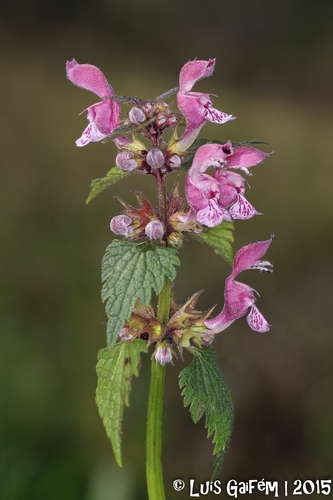
Spotted deadnettle
Lamium maculatum
A silver-tongued beauty of the shade, Spotted Deadnettle brightens dark garden corners while providing a critical nectar buffet for early-spring bumblebees.
Quick Identification
Size
Height of 15–25 cm (6–10 inches); spreads 30–90 cm (1–3 feet) wide
Colors
Silvery-white central stripe on green heart-shaped leaves; flowers range from deep pink and purple to pure white
Key Features
- Distinctive silver-variegated foliage
- Square stems characteristic of the Lamiaceae family
- Two-lipped, hooded flowers in whorls
- Dense, low-growing mat-like habit
When You’ll See Them
Behavior
Spotted deadnettle is a resilient perennial groundcover that acts as a vital early-season resource for backyard wildlife. Unlike its namesake, the stinging nettle, this species lacks stinging hairs, making it a friendly addition to shaded gardens. It spreads primarily through stolons—above-ground runners that root at the nodes—allowing it to form a dense carpet that suppresses weeds and provides cool, moist cover for ground-dwelling invertebrates.
In the spring and early summer, it is a hub of activity for long-tongued bees, particularly bumblebees, which are one of the few insects strong enough to push open the hooded flowers to reach the nectar inside. While it is non-aggressive compared to some of its relatives, it can be quite vigorous in damp, shaded areas where other plants struggle to grow.
EverydayEarth exclusive
Camera Tips
Capturing the beauty of spotted deadnettle requires a focus on macro details and the life it supports. Position your camera on a low-profile tripod or a ground mount, roughly 6 to 10 inches off the forest floor. Angle the lens slightly upward to capture the intricate structure of the hooded flowers against the silver-streaked leaves. Because this plant thrives in the shade, you may need to adjust your camera’s ISO to a slightly higher setting (400-800) to maintain a fast shutter speed, which is essential for freezing the motion of visiting pollinators.
To get the best 'wildlife' shots, treat the spotted deadnettle as a stage. Set your camera to a trigger-interval or time-lapse mode during the morning hours when bumblebees are most active. A fast trigger speed is vital, as bees move quickly between the individual flower whorls. If you are using an AI-powered camera, focus the detection zone on a particularly dense cluster of blooms. This is a great way to document the specific species of bees visiting your yard.
Seasonality plays a big role in your camera strategy. In the early spring, the new growth is exceptionally vibrant; use a polarizer filter if possible to cut the glare off the silver foliage and make the pink flowers pop. During the winter, the evergreen foliage of many cultivars provides an excellent backdrop for ground-foraging birds like Juncos or Sparrows, who may pick through the leaves for hidden insects. Experiment with a 'top-down' angle for time-lapses to show how the plant spreads its runners across the garden floor over several weeks.
Similar Species
Species that look similar or are commonly confused with Spotted deadnettle.
White Deadnettle
Features pure white flowers and lacks the silver mid-rib stripe typical of most L. maculatum cultivars.
Henbit
An annual with rounded, deeply lobed leaves that encircle the stem, unlike the petioled heart-shaped leaves of spotted deadnettle.
Yellow Archangel
Grows taller with yellow flowers and can be significantly more invasive in woodland environments.
Frequently Asked Questions
Record Spotted deadnettle at your habitat
Connect a camera to start building your own species record — AI identifies every visitor automatically.