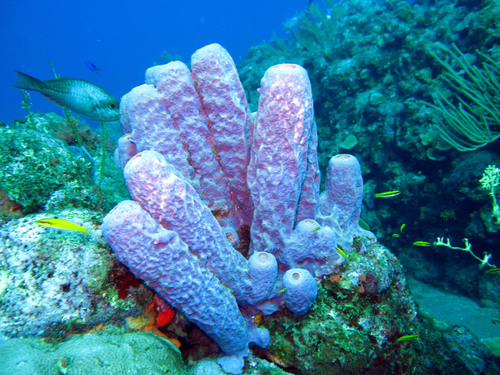
Stovepipe Sponge
Aplysina archeri
The Stovepipe Sponge is a towering architectural marvel of the Caribbean reefs, growing in vibrant lavender clusters that can reach five feet in height. These ancient filter feeders are the silent sentinels of the ocean, living for centuries and providing vital habitat for diverse marine life.
Quick Identification
Size
Individual tubes reach up to 1.5 meters (5 feet) in height and approximately 7.6 centimeters (3 inches) in diameter.
Colors
Commonly found in vibrant shades of lavender, pink, and purple, but can also appear in muted gray or brownish-tan hues.
Key Features
- Elongated, hollow cylindrical tubes resembling industrial stovepipes
- Often grows in clusters of up to 22 distinct tubes from a single base
- Surface has a fine, porous texture without prominent spines
- Vibrant monochromatic coloration that persists throughout the tube's length
When You’ll See Them
Geographic range
Where Does the Stovepipe Sponge Live?
Native to the tropical Western Atlantic Ocean, the Stovepipe Sponge is a hallmark species of the Caribbean basin. Its core range extends from the coral reefs of southern Florida and the Bahamas down through the Greater and Lesser Antilles to the coastal waters of Bonaire and Venezuela. These sponges are found exclusively in marine environments, favoring reef slopes where consistent currents provide a steady supply of nutrients.
Basemap © OpenStreetMap contributors
Behavior
The Stovepipe Sponge is a sessile organism, meaning it remains anchored to the reef floor for its entire adult life. Unlike many terrestrial animals, its behavior is defined by its interaction with the surrounding water currents. It acts as a biological filter, processing vast quantities of seawater through its porous walls to extract microscopic food particles. While it may look static, the sponge is a living engine of the reef, constantly pumping water and providing a structural habitat for smaller marine organisms.
These sponges are known for their incredibly slow growth rates and extreme longevity. They can live for hundreds of years, growing continuously until they die. Because they lack a nervous system, they do not exhibit complex social behaviors or interactions with humans beyond providing a visual spectacle for divers. However, they are sensitive to environmental changes; they react to water quality and can be severely impacted by sediment or pollutants that clog their delicate filtration pores.
EverydayEarth exclusive
Camera Tips
Capturing a Stovepipe Sponge on an underwater camera requires a focus on lighting and stability. Because colors like pink and lavender are the first to disappear as you descend into deeper water, using high-quality external strobes or video lights is essential to reveal the sponge's true brilliance. Position your lights at a 45-degree angle to the side of the tubes to avoid backscatter from floating particles in the water while highlighting the unique texture of the sponge's surface.
For those using fixed underwater housings or reef-cams, time-lapse photography is a fascinating way to document this species. While the sponge itself doesn't move, a time-lapse can capture the 'hidden' life of the sponge, such as the movement of predatory snails or the schools of small fish that use the tubes for protection. Set your camera to take a frame every 30 seconds over several hours to witness the reef's daily rhythm around the stationary sponge.
Composition is key when dealing with 5-foot-tall structures. To emphasize their impressive height, use a wide-angle lens and shoot from a slightly upward angle, known as a 'low-angle shot' in cinematography. This makes the tubes look majestic against the blue water column. Ensure your camera is securely mounted to a weighted tripod or a permanent reef fixture to prevent current-induced blur, and always check that your housing's seals are clear of sand before deployment.
Similar Species
Species that look similar or are commonly confused with Stovepipe Sponge.
Yellow Tube Sponge
Smaller in height and consistently bright yellow with a more textured, 'pitted' surface.
Giant Barrel Sponge
Much wider and sturdier with a hard, wood-like exterior, often described as the 'redwood of the reef.'
Branching Vase Sponge
Features a more flared, vase-like opening and typically grows in more irregular, sprawling patterns.
Frequently Asked Questions
Record Stovepipe Sponge at your habitat
Connect a camera to start building your own species record — AI identifies every visitor automatically.