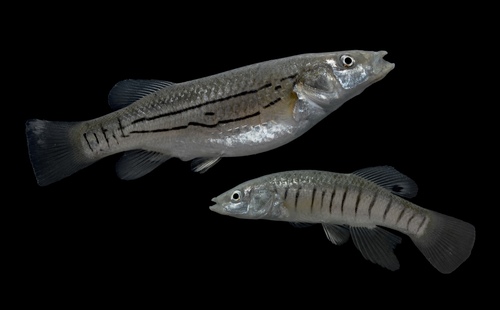
Striped Killifish
Fundulus majalis
The Striped Killifish is a resilient icon of the Atlantic coast, known for its striking patterns and incredible ability to survive the toughest tidal environments. A favorite for coastal observers, these hardy fish bring a flash of silver and shadow to every salt marsh and estuary.
Quick Identification
Size
4 to 7 inches (10 to 18 cm) in length; weighs approximately 0.5 to 1.5 oz (14 to 42 g)
Colors
Silvery-white belly with olive-green or grayish backs; females have 2-3 black horizontal stripes, while males have 15-20 vertical black bars
Key Features
- Distinct sexual dimorphism with horizontal stripes on females and vertical bars on males
- Large, prominent eyes and a flat-topped head
- Upturned, protractile mouth for surface feeding
- Stocky, cylindrical body tapering at the tail
When You’ll See Them
Geographic range
Where Does the Striped Killifish Live?
The Striped Killifish is a native fixture of the North American Atlantic coast. Its range stretches from the southern waters of New Hampshire down through the entire Eastern Seaboard to the tip of Florida. It also maintains a strong presence along the northern Gulf of Mexico, inhabiting the brackish lagoons and coastal marshes from Florida's west coast over toward Texas.
Basemap © OpenStreetMap contributors
Behavior
Striped Killifish are energetic, social fish that are almost always found in schools, ranging from a few individuals to several hundred. They are master survivors of the intertidal zone, possessing an incredible tolerance for fluctuating salinity and low oxygen levels that would drive away most other fish. They are frequently seen patrolling the very edge of the waterline, moving in and out with the tides to access nutrient-rich marsh surfaces.
One of their most remarkable behaviors is their ability to escape drying tide pools. If the tide recedes and leaves them stranded, the Striped Killifish can use its muscular body to flip and jump across mud or wet sand for several feet to reach open water. They are diurnal and spend most of their daylight hours foraging, often hovering just below the surface to snatch floating insects or dipping into the substrate for small crustaceans.
EverydayEarth exclusive
Camera Tips
Capturing the Striped Killifish on camera requires an underwater setup, such as an action camera in a waterproof housing or a specialized submersible trail cam. For the best results, place your camera in a shallow tidal creek or a permanent tide pool at low tide, aiming the lens horizontally toward a clear, sandy patch. Ensure the camera is weighted or staked down, as the incoming tide creates strong currents that can easily sweep away lightweight equipment.
To attract a school into the frame, use a small mesh bait bag filled with crushed blue crab, shrimp, or even bits of oily canned fish like sardines. Secure the bait about 10 to 15 inches in front of the lens. As the tide rises, the scent will draw the killifish in from the surrounding marsh. They are curious and competitive, so a single bait source often results in high-energy schooling footage with plenty of movement.
Lighting is your biggest challenge underwater. Try to position your camera so the sun is behind it or directly overhead (midday is best) to illuminate the fish's silvery scales and make the black stripes pop against the background. If you are filming in a salt marsh with heavy vegetation, look for 'gaps' in the seagrass where the fish naturally congregate to move between feeding grounds.
Similar Species
Species that look similar or are commonly confused with Striped Killifish.
Mummichog
Mummichogs have a more rounded, blunt snout and lack the distinct horizontal stripes found on female Striped Killifish.
Rainwater Killifish
Much smaller (rarely exceeding 2 inches) with a more translucent body and lack of distinct bold stripes or bars.
Sheepshead Minnow
Has a much deeper, diamond-shaped body profile compared to the slender, torpedo shape of the Striped Killifish.
Frequently Asked Questions
Record Striped Killifish at your habitat
Connect a camera to start building your own species record — AI identifies every visitor automatically.