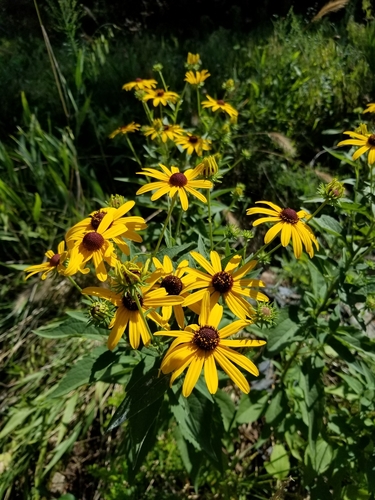
sweet black-eyed Susan
Rudbeckia subtomentosa
Famed for its sweet anise scent and golden-yellow blooms, the sweet black-eyed Susan is a cornerstone of the American prairie and a favorite for backyard pollinators.
Quick Identification
Size
3 to 5 feet (90–150 cm) tall with a spread of 1 to 2 feet (30–60 cm)
Colors
Bright yellow to gold ray florets with reddish-brown bases; dark brownish-purple center disks; grayish-green foliage
Key Features
- Sweet anise or vanilla fragrance from the crushed leaves and flowers
- Finely haired (subtomentose) stems and leaves providing a velvety feel
- Lower leaves are deeply divided into three lobes
- Flower heads feature 12–20 yellow petals surrounding a dark, dome-shaped center
When You’ll See Them
Geographic range
Where Does the sweet black-eyed Susan Live?
Native to the heart of North America, the sweet black-eyed Susan is primarily found throughout the central United States. Its core range extends from the Great Lakes region southward through the Mississippi Valley to the Gulf Coast, with high concentrations in states like Missouri, Illinois, and Arkansas. While it is a specialist of the tallgrass prairie ecosystem, it has been successfully introduced to managed landscapes and meadow restorations across much of the eastern United States.
Basemap © OpenStreetMap contributors
Behavior
Sweet black-eyed Susan is a long-lived perennial that brings structure and late-season color to the landscape. Unlike many other Rudbeckia species that act as short-lived biennials, this plant establishes a deep root system and returns reliably year after year. It is known for its sturdy, upright stems that rarely require staking, even when fully loaded with blooms during its peak season from late July through September.
In the wild, it serves as a critical late-summer nectar source for a diverse array of pollinators, including long-tongued bees, butterflies, and skippers. Humans prize it not just for its visual appeal but for its unique fragrance—a subtle, sweet scent reminiscent of anise or clover that wafts through the garden on warm, humid afternoons. It is a social plant in the ecosystem, often found growing in tight-knit colonies that provide excellent cover for ground-nesting birds.
EverydayEarth exclusive
Camera Tips
Capturing the sweet black-eyed Susan on a trail camera is all about focusing on the 'micro-wildlife' it attracts. To get the best shots of visiting butterflies and bees, mount your camera on a garden stake approximately 3 to 4 feet off the ground, positioning it about 2 feet away from a cluster of healthy blooms. Use a macro lens attachment if available, or set your camera to its closest focus setting to capture the intricate details of the pollinators' wings against the bright yellow petals.
Lighting is your best friend with this species. Aim your camera toward the east or west to take advantage of the 'golden hour' light, which makes the yellow petals glow and highlights the fine, silvery hairs on the stems. If your camera has a high-speed trigger or a 'burst mode,' enable it; this is essential for freezing the motion of fast-moving insects like the clearwing hummingbird moth, which is a frequent visitor to these flowers.
For a unique perspective, try a time-lapse setting over a period of 4 to 6 hours during a sunny day. This will capture the subtle movement of the flower heads tracking the sun and the constant bustle of pollinator activity. In the late fall, don't take your camera down; the dried, dark seed heads are a magnet for American Goldfinches, providing a great opportunity to capture bird behavior in the 'off-season.'
Similar Species
Species that look similar or are commonly confused with sweet black-eyed Susan.
Black-eyed Susan
Shorter lived (biennial), lacks the anise scent, and has simple, unlobed leaves covered in much coarser hairs.
Brown-eyed Susan
Produces much smaller flower heads in greater numbers and typically has more branched, shrub-like growth.
Orange Coneflower
Features deeper orange-yellow petals and lacks the fuzzy 'subtomentose' texture on the stems.
Frequently Asked Questions
Record sweet black-eyed Susan at your habitat
Connect a camera to start building your own species record — AI identifies every visitor automatically.