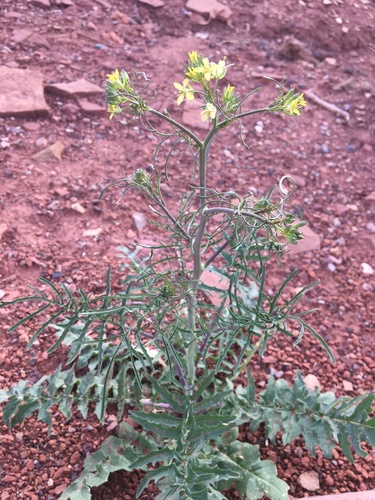
Tall Tumblemustard
Sisymbrium altissimum
Witness the incredible transformation of the Tall Tumblemustard, a backyard traveler that evolves from a delicate yellow wildflower into a wandering tumbleweed. This resilient mustard species is a master of using the wind to plant the seeds of its next generation.
Quick Identification
Size
2 to 5 feet (60 to 150 cm) in height; can spread 1 to 3 feet (30 to 90 cm) wide
Colors
Pale yellow to creamy-white flowers; bright green stems and leaves that turn a dry straw-yellow or tan at maturity
Key Features
- Tiny four-petaled flowers in pale yellow clusters
- Deeply lobed lower leaves with thread-like upper leaves
- Highly branched, skeleton-like appearance when mature
- Long, thin seed pods (siliques) up to 4 inches long
- Snap-away base that allows the plant to tumble in the wind
When You’ll See Them
Behavior
Tall Tumblemustard is a master of adaptation and movement. It begins its life cycle as a ground-hugging rosette of deeply lobed leaves, which allows it to establish a strong taproot while staying protected from the elements. Once the weather warms, it undergoes a rapid vertical growth phase known as bolting, developing a stiff, widely-branching structure that can reach shoulder height on a human. This architecture is designed to support thousands of small flowers and even more seeds.
The plant’s most iconic behavior occurs after it dies in late summer. As the tissues dry out, the base of the stem becomes incredibly brittle. A stiff breeze is enough to snap the plant from its root, sending the entire skeletal structure rolling across the landscape. This 'tumbleweed' action isn't just for show; it is a highly effective seed-dispersal strategy, scattering seeds over vast distances as the plant bounces along fences and open fields.
EverydayEarth exclusive
Camera Tips
To capture the fascinating life cycle of Tall Tumblemustard, start by setting your camera to a time-lapse mode in late spring. This species is one of the fastest 'bolters' in the backyard; a photo taken every four hours will showcase the plant's transformation from a flat green rosette to a five-foot-tall branched skeleton in just a matter of weeks. Position your camera on a low tripod to get a 'worm's eye view' of the stem as it ascends toward the sky.
During the flowering stage in early summer, the pale yellow blooms attract a variety of small pollinators including hoverflies and cabbage white butterflies. To photograph these visitors, use a high-speed trigger setting. Because the plant's branches are very thin and act like springs in the wind, you will need a fast shutter speed (at least 1/500s) to avoid motion blur. Focus your lens on the terminal clusters at the very ends of the branches, as this is where the most insect activity occurs.
The real challenge and reward come in the autumn. To capture the 'tumbleweed' in action, place your camera near a boundary like a chain-link fence or a line of shrubs where wind-blown debris naturally accumulates. Use a wide-angle lens and set your motion trigger to 'High' to capture the plant as it rolls into frame. This provides a unique perspective on the plant's movement that is rarely seen in standard botanical photography. Avoid using a flash at night during the dry phase, as the straw-colored branches are highly reflective and can easily overexpose the shot.
Similar Species
Species that look similar or are commonly confused with Tall Tumblemustard.
Hedge Mustard
Hedge mustard is much shorter and has seed pods that pressed tightly against the stem, whereas Tall Tumblemustard's pods spread outward.
London Rocket
London Rocket has deeper yellow flowers and more succulent-looking leaves that stay lower to the ground.
Garlic Mustard
Garlic Mustard has broad, heart-shaped leaves and white flowers, unlike the thin leaves and yellow flowers of the tumblemustard.
Frequently Asked Questions
Record Tall Tumblemustard at your habitat
Connect a camera to start building your own species record — AI identifies every visitor automatically.