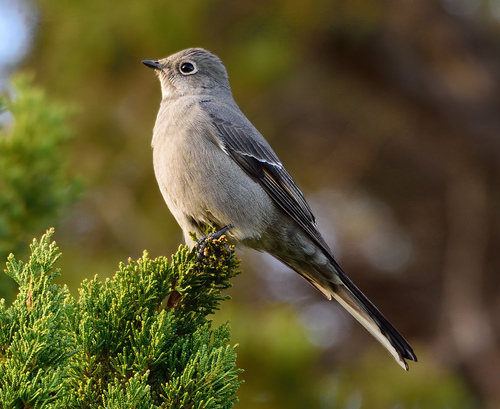
Townsend's Solitaire
Myadestes townsendi
The Townsend's Solitaire is a master of the high-country winter, a silvery-gray thrush that defends its berries with vigor. Often found atop the highest pine, its hauntingly beautiful song is a rare treat in the quiet of a mountain forest.
Quick Identification
Size
Length: 8-9.5 in (20-24 cm); Wingspan: 13-14.5 in (33-37 cm); Weight: 1.1-1.2 oz (30-35 g)
Colors
Uniform brownish-gray body; distinct narrow white eye-ring; buffy-orange wing patches; dark tail with white outer feathers; no major difference between males and females.
Key Features
- Distinct white eye-ring
- Buffy wing patches visible in flight
- Long tail with white outer margins
- Upright, hunched posture on high perches
When You’ll See Them
Behavior
Townsend's Solitaires are the rugged individualists of the thrush family. Unlike their social relatives like the American Robin, these birds are fiercely solitary. During the winter, they claim and defend strict feeding territories centered around juniper trees. They spend much of their time perched motionless on the very highest branch of a tree, acting as a sentinel to guard their food source from intruders like Cedar Waxwings.
Their flight is graceful and somewhat swallow-like, consisting of fluid wingbeats and long glides. Despite their name and somewhat shy reputation, they are remarkable vocalists. They are one of the few bird species that will sing a complex, warbling song throughout the winter, using it as a tool to advertise their territory ownership even in the middle of a snowstorm.
EverydayEarth exclusive
Camera Tips
To capture high-quality footage of a Townsend’s Solitaire, your best bet is to focus on water and winter fruit. Because these birds subsist on dry berries during the colder months, they are frequent visitors to bird baths. A heated bird bath is a magnet for them. Position your camera at eye level with the water's edge, roughly 3 to 5 feet away, to capture the fine detail of their white eye-ring and the subtle textures of their gray plumage.
Placement is key when dealing with their "sentinel" behavior. If you have a tall, snag-topped tree or a prominent high branch near a berry source, aim your camera there. Solitaires love to sit on the "top-most" twig. If using a trail camera, mount it 6 to 8 feet up a neighboring tree and angle it slightly upward toward these preferred perches. Use a high shutter speed or 60fps video setting to catch the quick, darting movements they make when sallying out to catch a passing insect or defending their tree.
Avoid placing cameras near standard seed feeders, as Solitaires will rarely visit them. Instead, look for Juniper, Mountain Ash, or Burning Bush. If you can identify a bird’s "defended" tree, place your camera with the sun behind it to illuminate the bird’s front. The buffy patches on their wings are their most striking feature, but they are often hidden when the bird is perched; a camera triggered by the motion of the bird landing or taking off from a berry cluster will provide the best chance to see these colors.
Similar Species
Species that look similar or are commonly confused with Townsend's Solitaire.
Northern Mockingbird
Mockingbirds have pale eyes and large white wing flashes, whereas Solitaires have a dark eye with a white ring and smaller buffy wing patches.
Mountain Bluebird
Female Mountain Bluebirds are gray but usually show distinct blue tints in the wings and tail and have a more rounded, less elongated body.
Sage Thrasher
The Sage Thrasher has a heavily streaked breast and a shorter tail compared to the uniform gray breast of the Solitaire.
Frequently Asked Questions
Record Townsend's Solitaire at your habitat
Connect a camera to start building your own species record — AI identifies every visitor automatically.