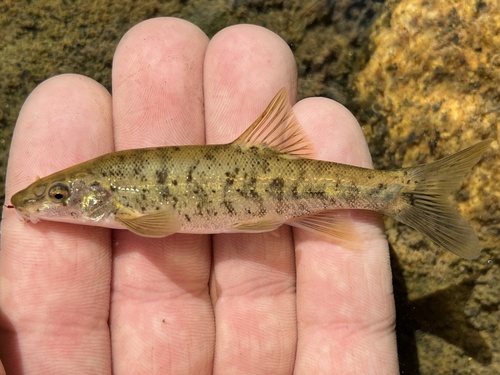
Umatilla Dace
Rhinichthys umatilla
A master of the Pacific Northwest's rushing currents, the Umatilla Dace is a hardy survivor of the Columbia River basin. With its mottled camouflage and specialized streamline body, it thrives in the rocky riffles where few other fish dare to stay.
Quick Identification
Size
7.5–12 cm (3–4.7 inches) in length; typically weighs less than 30 grams (1 ounce)
Colors
Mottled olive-brown or greyish upper body, silvery or cream-colored belly, and a dark lateral stripe that may be faint in adults
Key Features
- Distinctive subterminal mouth with a small frenum
- Slender, hydrodynamic body shape
- Deeply forked caudal fin
- Small scales and a mottled pattern for riverbed camouflage
When You’ll See Them
Geographic range
Where Does the Umatilla Dace Live?
The Umatilla Dace is native to the Pacific Northwest of North America, where it is an endemic specialist of the Columbia River drainage system. Its range spans from southern British Columbia in Canada down through the heart of Washington and Oregon, extending eastward into the Snake River plains of Idaho. Because it is tied strictly to the Columbia basin, it is a key biological indicator for the health of these major western waterways.
Basemap © OpenStreetMap contributors
Behavior
The Umatilla Dace is a highly specialized river dweller that spends the majority of its life hugging the bottom of swift-moving currents. Unlike many other small fish that prefer the calm of backwaters, this species has evolved to navigate the turbulent 'riffles' of large river systems. They are strong swimmers for their size, using their pectoral fins to wedge themselves against rocks to conserve energy while searching for food.
Socially, Umatilla Dace are relatively gregarious and are often found in mixed schools with other dace species or juvenile suckers. They do not exhibit complex social hierarchies but rely on the safety of numbers to avoid larger predatory fish like Bull Trout or Northern Pikeminnow. While they are sensitive to human-led habitat changes, they are not naturally aggressive and will simply dart into the crevices of the riverbed if disturbed by waders or swimmers.
EverydayEarth exclusive
Camera Tips
Capturing the Umatilla Dace requires an underwater setup, as they rarely surface and prefer the deepest parts of the river's fast-moving sections. For the best results, use an action camera with a waterproof housing mounted to a heavy lead or steel base to ensure the current doesn't sweep it away. Position the camera in a 'riffle'—a shallow section of the river where water ripples over rocks—and point the lens slightly upstream at a 45-degree angle to catch the fish as they move against the current.
Lighting is your biggest challenge underwater. Try to film during midday when the sun is directly overhead to pierce through the water column. If the water is deep or murky, an external waterproof LED light can help, but place it several inches away from the lens to avoid 'backscatter' from floating debris. Setting your camera to a high frame rate (at least 60fps) is essential, as dace are incredibly quick and jittery in their movements; slow-motion playback will allow you to see their unique feeding behavior more clearly.
While traditional baiting can be difficult in fast water, you can attract them by 'chumming' the water upstream. Gently turning over a few large rocks just above your camera site will release natural insect larvae into the drift, which will often draw a school of dace directly in front of your lens within minutes. Ensure your camera is set to a wide-angle view, as these fish like to dart in and out of the crevices between the cobble stones.
Similar Species
Species that look similar or are commonly confused with Umatilla Dace.
Longnose Dace
Has a much longer, more prominent snout that overhangs the mouth significantly compared to the Umatilla.
Leopard Dace
Features much darker, distinct 'leopard' spots on the sides and prefers slightly slower water velocities.
Speckled Dace
Generally smaller with a more pointed snout and more uniform speckling across the entire body.
Frequently Asked Questions
Record Umatilla Dace at your habitat
Connect a camera to start building your own species record — AI identifies every visitor automatically.