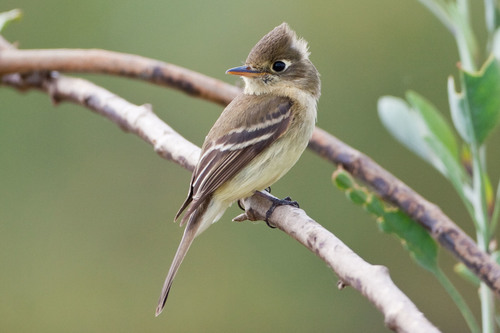
Western Flycatcher
Empidonax difficilis
A master of the shaded understory, the Western Flycatcher is a small but spirited bird known for its distinctive teardrop-shaped eye ring and acrobatic aerial hunts. Spotting one is a rewarding challenge for any backyard birder looking to master the art of flycatcher identification.
Quick Identification
Size
Length: 5–6.7 in (13–17 cm); Wingspan: 8–9.5 in (20–24 cm); Weight: 0.3–0.4 oz (9–12 g)
Colors
Olive-green to brownish-gray upperparts, yellowish wash on the belly and throat, and two pale wing bars. Males and females look identical.
Key Features
- Distinctive teardrop-shaped or almond-shaped white eye ring
- Small, thin bill with a noticeably pale or pinkish-orange lower mandible
- Yellowish throat that contrasts with a darker olive chest band
- Longer-tailed appearance compared to other small flycatchers
When You’ll See Them
Behavior
The Western Flycatcher is a patient and methodical hunter, spending much of its day perched on low to mid-story branches under the forest canopy. From these vantage points, it performs a classic 'sallying' maneuver—darting out into the air to snatch a passing insect with an audible snap of its bill before returning to the same branch or a nearby spot to scan for its next meal.
While they are socially monogamous during the breeding season, Western Flycatchers are generally solitary birds that prefer the quiet of shaded, moist environments. They are more often heard than seen; their sharp, rising 'ps-it' or 'seet' call is a hallmark of Western woodlands. In backyard settings, they are less bold than robins or jays, preferring to stay within the protection of leafy shrubs or dense ornamental trees.
EverydayEarth exclusive
Camera Tips
To capture the elusive Western Flycatcher, camera placement is everything. These birds favor 'edge habitats'—the transition zone between dense foliage and open space where they can easily spot flying insects. Aim your camera at horizontal, dead branches situated 4 to 8 feet off the ground, particularly those in the shade. Because they often return to the same 'sentinel perch' repeatedly, once you identify a bird using a specific branch, that is your prime monitoring spot.
Water is a massive draw for this species, especially during the heat of the afternoon. Unlike many birds that wade into a bath, flycatchers often prefer to 'dip-bathe,' flying down to touch the water's surface and then retreating to a branch to preen. Position your camera at eye-level with a birdbath or a trickling water feature. Use a fast shutter speed or a high-frame-rate video setting (at least 60fps) to catch the split-second action of their aerial maneuvers without motion blur.
Since these birds are small and move incredibly fast, set your AI camera's sensitivity to high. If your camera allows for zone-based triggering, focus the 'hot zone' on the perch itself rather than the background foliage to avoid false triggers from wind-blown leaves. Because they are early risers, ensure your camera has good low-light performance or is positioned to catch the soft morning sun as it filters through the canopy.
In late spring, look for Western Flycatchers investigating sheltered ledges, beams under eaves, or thick ivy on walls. They are one of the few flycatchers that will occasionally nest on man-made structures that mimic a natural rock crevice. If you notice a pair lingering around your porch or shed, a strategically placed camera (mounted at a respectful distance of at least 10 feet) can provide an incredible look at their nesting cycle without disturbing the birds.
Similar Species
Species that look similar or are commonly confused with Western Flycatcher.
Hammond's Flycatcher
Hammond's has shorter primary feathers and a smaller, entirely dark bill compared to the Western's pale lower mandible.
Willow Flycatcher
Willow Flycatchers lack the distinct white eye ring and have a much more brownish-gray overall tone.
Dusky Flycatcher
The Dusky Flycatcher has a rounder eye ring and lacks the strong yellow wash on the throat seen on the Western.
Frequently Asked Questions
Record Western Flycatcher at your habitat
Connect a camera to start building your own species record — AI identifies every visitor automatically.