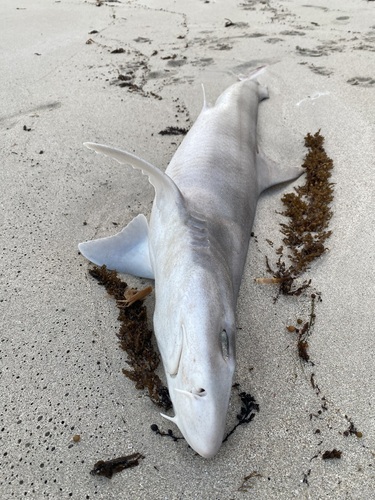
Whiskery Shark
Furgaleus macki
Meet the 'whiskered' specialist of the Australian reefs. This unique houndshark is a master of the seafloor, easily identified by its distinctive nasal barbels and humpbacked silhouette.
Quick Identification
Size
Typically reaches 1.2 to 1.5 metres (3.9 to 4.9 feet), with a maximum length of 1.6 metres (5.2 feet).
Colors
Brownish-gray upper body with a lighter, creamy-white underside; juveniles feature dark saddles and blotches that fade into a uniform color with age.
Key Features
- Distinctive long nasal barbels (whiskers) near the nostrils
- Two dorsal fins of nearly equal size located toward the back
- Stout, thick-set body with a visible 'humpbacked' profile
- Small, sharp teeth specialized for gripping octopuses
When You’ll See Them
Geographic range
Where Does the Whiskery Shark Live?
The Whiskery Shark is a proud Australian local, found nowhere else in the world. Its range extends across the southern half of the continent, stretching from the tropical-temperate transition zone off North West Cape in Western Australia, down around the southwestern coast, and eastward through the Great Australian Bight to the Bass Strait. It is most commonly found in the nutrient-rich, temperate waters of the Western Australian shelf.
Basemap © OpenStreetMap contributors
Behavior
The Whiskery Shark is a specialized bottom-dweller that spends its life patrolling the rugged seafloors of the Australian continental shelf. Unlike many of its more streamlined relatives, this shark is built for maneuverability among rocks and weeds rather than high-speed chases. It is a solitary species that uses its sensitive nasal barbels to 'taste' the water and detect the scent of prey hiding in deep crevices and kelp forests.
These sharks are remarkably docile and pose no threat to humans, often ignoring divers or moving away slowly when approached. They are most active during the twilight hours of dawn and dusk, though they can be found foraging at any time of day or night. Their social life is limited, though they are known to congregate in specific nursery areas where females give birth to live young after a gestation period of about 7 to 9 months.
EverydayEarth exclusive
Camera Tips
To capture the Whiskery Shark on an underwater camera, focus your efforts on the transition zones where rocky reefs meet sandy patches or seagrass beds. Using a Baited Remote Underwater Video (BRUV) system is the most effective method. Because these sharks are cephalopod specialists, the best lure is a mesh bag filled with oily fish or, even better, fresh octopus or squid offcuts. The scent trail will draw them out from the reef and right in front of your lens.
Mount your camera at a low angle, approximately 20-40 centimeters from the seabed, facing slightly upward. This positioning captures the shark's unique 'humpbacked' silhouette and clearly shows the diagnostic nasal barbels as it investigates the bait. If you are filming in the early morning or late evening—their peak activity times—ensure you use a wide-angle light source. Red lights are preferable as they are less likely to startle the shark than bright white LEDs.
Stability is key when dealing with the surge and currents of the Australian shelf. Use a weighted base or a tripod tethered to a fixed point to prevent your camera from shifting. Because these sharks are stout and can be quite curious, they may occasionally bump the camera; ensure your housing is rugged and the mount is secure. Set your camera to record in short intervals (2-3 minutes) triggered by motion if possible, or use a continuous loop to catch their slow, methodical approach.
Similar Species
Species that look similar or are commonly confused with Whiskery Shark.
Gummy Shark
Lacks nasal barbels and has a first dorsal fin that is noticeably larger than the second.
School Shark
Features a more slender, streamlined body and a distinctively notched lower lobe on the tail fin.
Draughtboard Shark
Has a much broader head and a highly variegated 'checkerboard' color pattern that persists into adulthood.
Frequently Asked Questions
Record Whiskery Shark at your habitat
Connect a camera to start building your own species record — AI identifies every visitor automatically.