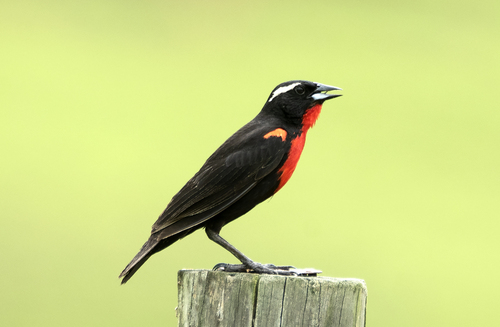
White-browed Meadowlark
Leistes superciliaris
With a chest as red as a sunset and a striking white racing stripe above the eye, the White-browed Meadowlark is the crown jewel of the South American grasslands.
Quick Identification
Size
Length: 17-18.5 cm (6.7-7.3 in); Weight: 40-52 g (1.4-1.8 oz)
Colors
Males are soot-black with a brilliant red throat and breast and a bold white stripe above the eye. Females are streaked brown and buff with a pale throat.
Key Features
- Bold white supercilium (eyebrow) stripe
- Brilliant crimson throat and breast on males
- Short, slightly notched tail
- Pointed, conical bill
- Streaked, cryptic plumage on females
When You’ll See Them
Behavior
The White-browed Meadowlark is a charismatic inhabitant of open landscapes. During the breeding season, males are highly conspicuous as they claim territories by perching on fence posts, shrubs, or tall grass stalks. They perform a signature display flight, fluttering upward into the air before gliding back down to their perch while emitting a wheezy, buzzy song. Unlike many other songbirds that hop, these meadowlarks walk or run across the ground with a purposeful gait.
Outside of the breeding season, they become more gregarious, often forming small flocks that move through pastures and agricultural fields in search of food. They are generally shy around humans but have adapted remarkably well to rural and suburban edges where open grasslands are maintained. They are ground-nesters, concealing their cup-shaped nests deep within dense clumps of grass to protect them from predators.
EverydayEarth exclusive
Camera Tips
To successfully capture the White-browed Meadowlark on your AI camera, location is everything. These birds are 'post-perchers,' meaning they instinctively seek out the highest point in a flat field to sing and survey their territory. If you have a fence line, mount your camera directly onto a fence post or aim it at a prominent shrub about 3 to 4 feet off the ground. Angling the camera slightly upward will help capture the bird against the sky, highlighting the male’s vibrant red chest against the horizon.
Because they are ground foragers, you can also attract them by creating a 'lure zone' in a patch of short grass. Unlike forest birds, meadowlarks are hesitant to visit enclosed feeders. Instead, use a low-profile ground tray or simply scatter mealworms and crushed seeds in a clear area. Position your camera about 5 feet away from this spot, mounted at a very low 'worm's-eye' angle (6-12 inches off the ground). This perspective provides stunning, intimate shots of their walking behavior and intricate feather patterns.
Timing and light are your best friends with this species. The male's red plumage can look washed out in harsh midday sun, so set your camera to be most active during the 'golden hours' of early morning and late afternoon. If your camera allows for sensitivity adjustments, set it to high, as their movements on the ground can be quick and erratic. During the peak breeding months, look for areas where the grass is slightly taller; placing a camera near a known water source or a shallow ground-level birdbath is one of the most reliable ways to get them to stay still for a clear photo.
Similar Species
Species that look similar or are commonly confused with White-browed Meadowlark.
Red-breasted Meadowlark
The Red-breasted Meadowlark lacks the distinct white eyebrow stripe and is typically found in more northerly regions of South America.
Long-tailed Meadowlark
Larger with a significantly longer tail and a more robust bill; the red on its chest is more localized and it lacks the clean white supercilium.
Pampas Meadowlark
Has a yellow breast instead of red, though the body shape and ground-dwelling habits are very similar.
Frequently Asked Questions
Record White-browed Meadowlark at your habitat
Connect a camera to start building your own species record — AI identifies every visitor automatically.