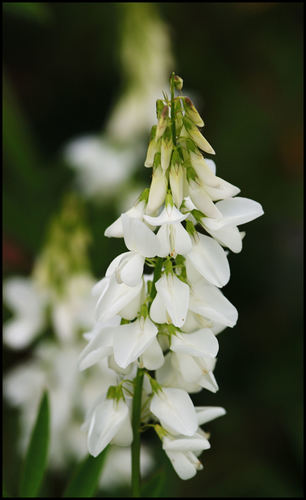
White Sweetclover
Melilotus albus
A towering champion of the meadow, White Sweetclover is a nitrogen-fixing powerhouse that fills the summer air with the scent of sweet vanilla and attracts a dizzying array of pollinators.
Quick Identification
Size
Stands 0.5 to 2.5 meters (2 to 8 feet) tall with branching stems.
Colors
Bright white flowers; light to medium green foliage; stems may be slightly reddish at the base.
Key Features
- Tiny white pea-like flowers on long, slender racemes
- Trifoliate leaves with finely toothed margins
- Distinctive sweet, vanilla-like scent when crushed or dried
- Tall, erect, and highly branched stem structure
When You’ll See Them
Geographic range
Where Does the White Sweetclover Live?
White Sweetclover is a globetrotting legume that traces its origins back to the vast temperate landscapes of Europe and Asia. Since its introduction to other continents as a forage crop and honey plant, it has successfully colonized much of North America, where it can be found from the southern reaches of the United States deep into the Canadian provinces. This hardy plant is equally at home in the temperate regions of Australia and South America, flourishing wherever it finds sun-drenched, disturbed soil.
Basemap © OpenStreetMap contributors
Behavior
White Sweetclover is a biennial or sometimes annual legume known for its vigorous growth and impressive ability to improve soil quality. In its first year, it focuses on developing a deep, sturdy taproot and a lush rosette of leaves. By the second year, it shoots upward, producing thousands of small, fragrant white flowers that are a major draw for pollinators. This plant is a pioneer species, often the first to colonize disturbed ground, where it works behind the scenes to fix atmospheric nitrogen into the soil.
While it is beloved by beekeepers for its high nectar production, it is also highly competitive. It can form dense stands that shade out native prairie species. Its interaction with humans is a mixed bag: farmers value it as a high-protein forage and soil builder, while conservationists often manage it as an invasive species in sensitive grasslands. The plant’s most famous trait is its sweet aroma, caused by the chemical coumarin, which intensifies as the plant dries.
EverydayEarth exclusive
Camera Tips
To capture the beauty of White Sweetclover, you should focus your camera on the flower spikes (racemes) during their peak bloom in mid-summer. Because the plant can grow up to 8 feet tall, mount your trail camera on a sturdy stake or a nearby fence post at a height of 3 to 5 feet, angled slightly upward to capture the full silhouette against the sky, or level with the flowers to catch visiting insects.
Since this species is a premier honey plant, the real action happens during the day. Use a camera with a high-speed shutter or a 'burst' mode to freeze the motion of honeybees, bumblebees, and butterflies that frequent the blossoms. For the best lighting, position your camera to take advantage of the early morning or late afternoon 'golden hour,' which makes the bright white flowers pop against the green foliage without the harsh glare of midday sun.
If you are using a backyard AI camera, place it near a cluster of clover during a calm day. Wind is the biggest challenge when filming tall, thin plants like Sweetclover, as they tend to sway and trigger false motions. Use a faster trigger speed and consider using a small garden stake to subtly tether the main stem if you are trying to get a stable time-lapse of the flowering process.
Similar Species
Species that look similar or are commonly confused with White Sweetclover.
Yellow Sweetclover
Features bright yellow flowers and generally begins blooming a few weeks earlier than the white variety.
White Clover
A low-growing, creeping plant with round, ball-like flower heads rather than tall vertical spikes.
Alfalfa
Has clusters of purple flowers and more rounded leaflets compared to the elongated spikes of Sweetclover.
Frequently Asked Questions
Record White Sweetclover at your habitat
Connect a camera to start building your own species record — AI identifies every visitor automatically.