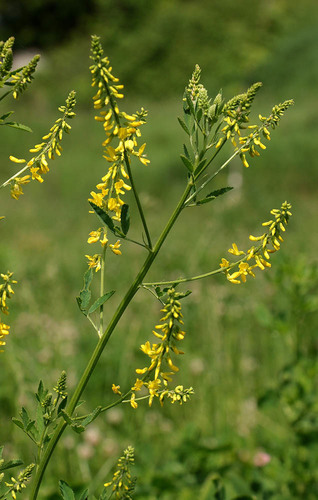
Yellow Sweetclover
Melilotus officinalis
A tall, fragrant biennial known for its vibrant yellow flower spikes and incredible ability to attract honeybees. While often found along sunlit roadsides, this hardy legume plays a vital role in soil health and pollinator support.
Quick Identification
Size
Stands 0.6 to 2 meters (2 to 6.5 feet) tall with a spread of 30 to 60 cm (1 to 2 feet).
Colors
Bright yellow flower spikes; clover-like green foliage with three leaflets.
Key Features
- Tall spikes of small yellow pea-like flowers
- Trifoliate leaves with finely toothed margins
- Sweet, vanilla-like scent of dried hay when crushed
- Erect, branched stems that can become woody at the base.
When You’ll See Them
Geographic range
Where Does the Yellow Sweetclover Live?
Native to the vast landscapes of Eurasia, Yellow Sweetclover has successfully traveled across the globe, establishing itself as a hardy pioneer species in North America, Africa, and Australia. In its introduced ranges, it thrives from the southern United States through the Canadian provinces, often dominating open prairies and roadsides where soil has been disturbed. It is particularly common in temperate zones where it was historically planted for soil stabilization and livestock forage.
Basemap © OpenStreetMap contributors
Behavior
Yellow Sweetclover is a biennial herb, meaning it completes its life cycle over two years. In the first year, it focuses on developing a deep taproot and a low-growing rosette of leaves. During the second year, the plant bolts rapidly, reaching heights of up to six feet, and produces an abundance of nectar-rich yellow flowers from late spring through summer. It is a member of the legume family, which allows it to improve soil quality by fixing nitrogen through a symbiotic relationship with soil bacteria.
This plant is highly valued by beekeepers because it produces prolific amounts of high-quality nectar, often resulting in a distinctively light, mild honey. However, it is also highly opportunistic; a single plant can produce tens of thousands of seeds that remain viable in the soil for over 30 years. While it provides excellent forage for honeybees and some wildlife, it is often considered an invasive species in North America where it outcompetes native prairie vegetation.
EverydayEarth exclusive
Camera Tips
Capturing the beauty of Yellow Sweetclover requires a different approach than filming mobile wildlife. To get the best results, place your camera on a tripod or stable mount at a height of about 3 to 4 feet, angling it slightly upward to capture the full height of the flowering spikes against the sky. Because this plant can grow quite tall, avoid placing the camera too close, or you may end up with a blurry foreground when the wind blows.
Yellow Sweetclover is a magnet for insect life, making it a perfect 'stage' for capturing pollinators. Set your camera to a high-speed trigger or video mode to catch bees, butterflies, and hoverflies as they move between the tiny yellow blossoms. Since the plant sways significantly in the breeze, use a faster shutter speed if your camera settings allow, or try to position the camera during the calm early morning hours when the light is soft and the air is still.
For a truly unique perspective, use a time-lapse setting over several weeks in late spring. This allows you to document the rapid 'bolting' phase where the plant shoots up from a small mound to a towering floral display. Be mindful of the sun's position; backlighting the flowers during the 'golden hour' can make the yellow petals appear to glow, creating stunning visual content for your backyard gallery.
If you are using an AI-powered camera that triggers on motion, be aware that tall sweetclover stems can cause 'false triggers' on windy days. To mitigate this, clear any very close vegetation that might whip directly in front of the lens, and focus your detection zone on the upper half of the plant where the flowers are most concentrated. This ensures you capture the visiting wildlife rather than just the wind in the leaves.
Similar Species
Species that look similar or are commonly confused with Yellow Sweetclover.
White Sweetclover
Nearly identical in structure and scent, but features white flowers and typically blooms slightly later in the season.
Alfalfa
Lower growing with purple flowers clustered in rounder heads rather than long, thin spikes.
Bird's-foot Trefoil
Much shorter and more creeping in habit, with larger, bright yellow flowers that resemble tiny slippers.
Frequently Asked Questions
Record Yellow Sweetclover at your habitat
Connect a camera to start building your own species record — AI identifies every visitor automatically.