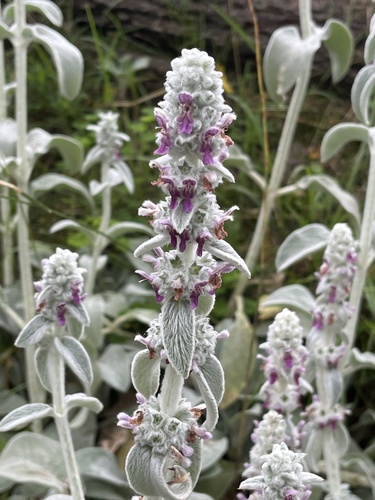
woolly hedgenettle
Stachys byzantina
Famous for its incredibly soft, silver-felted leaves, the Woolly Hedgenettle is a sensory masterpiece. This resilient groundcover is a favorite for both beginning gardeners and native pollinators like the Wool Carder Bee.
Quick Identification
Size
Stands 15 to 45 cm (6 to 18 inches) tall with a spread of 30 to 90 cm (12 to 36 inches)
Colors
Silvery-gray to pale sage green foliage; small, hooded flowers in shades of light purple, pink, or white
Key Features
- Thick, velvety leaves covered in dense white or silver hairs
- Low-growing, mat-forming rosettes
- Tall, erect flower spikes reaching up to 18 inches
- Soft, ear-shaped foliage that remains semi-evergreen in mild climates
When You’ll See Them
Geographic range
Where Does the woolly hedgenettle Live?
Native to the temperate hillsides and rocky meadows of Western Asia, including Turkey, Armenia, and Iran, the Woolly Hedgenettle has since become a global garden staple. It has successfully naturalized across much of North America and Europe, where it often escapes cultivation to grow in sunny, well-drained waste areas. Because it is highly adaptable to various soil types, it can now be found in temperate regions across every continent except Antarctica.
Basemap © OpenStreetMap contributors
Behavior
Woolly Hedgenettle, widely known as Lamb's-ear, is a hardy perennial herb that is primarily celebrated for its tactile, felt-like foliage. Rather than growing vertically like many garden flowers, it behaves as a vigorous groundcover, spreading through both self-seeding and creeping underground stems called rhizomes. Its silver leaves are not just for show; the dense coat of hair (trichomes) serves as a biological defense mechanism, reflecting intense sunlight to prevent scorch and trapping a layer of air against the leaf surface to reduce moisture loss during droughts.
In the garden ecosystem, this plant is a favorite of the Wool Carder Bee, which scrapes the "fuzz" from the leaves to line its nests. While the plant itself is stationary, it serves as a central hub for insect activity. In mid-summer, it sends up thick, woolly spikes adorned with tiny flowers. While these flowers are small, they are rich in nectar and attract a wide variety of bees and butterflies. Humans have historically used the soft leaves as a natural bandage or "woundwort" due to their absorbent and mildly antibacterial properties.
EverydayEarth exclusive
Camera Tips
When setting up a camera to capture Woolly Hedgenettle, the biggest challenge is the plant's high reflectivity. The silver hairs on the leaves can easily overexpose your image in direct sunlight, leading to a "blown-out" white appearance. To counter this, position your camera at a 45-degree side-angle rather than directly facing the sun, or place it in a spot that receives filtered morning light. Use a low tripod setting, roughly 10-15 inches off the ground, to capture the intricate textures of the leaves against the soil.
Because this plant is a magnet for the Wool Carder Bee, it provides an excellent opportunity for insect photography. Set your camera's trigger to high sensitivity and focus on a specific flower spike. Since these bees move quickly as they harvest the leaf fibers, a high shutter speed or a camera with a dedicated macro-focusing AI is essential. The best time for this action is mid-morning, between 8 AM and 11 AM, when pollinators are most active but the light is not yet too harsh.
For those interested in long-term projects, Woolly Hedgenettle is a perfect subject for time-lapse photography. Set your camera to take one photo every 6 hours starting in early spring. You will be able to document the remarkable transition from a dormant, flat rosette to a lush, silver carpet, and finally the dramatic upward thrust of the flower spikes. Ensure your camera is mounted on a fixed, weather-proof stake, as the plant's preferred open habitats are often subject to wind that can cause blurring in time-lapse sequences.
Similar Species
Species that look similar or are commonly confused with woolly hedgenettle.
Rose Campion
Features brighter, flat magenta flowers and more lance-shaped leaves compared to the hooded purple spikes of Lamb's-ear.
Silver Sage
Has much larger, wider rosettes of silver leaves and a more dramatic, branched flowering structure.
Snow-in-Summer
A much lower-growing groundcover with tiny, narrow leaves and prolific white star-shaped flowers.
Frequently Asked Questions
Record woolly hedgenettle at your habitat
Connect a camera to start building your own species record — AI identifies every visitor automatically.