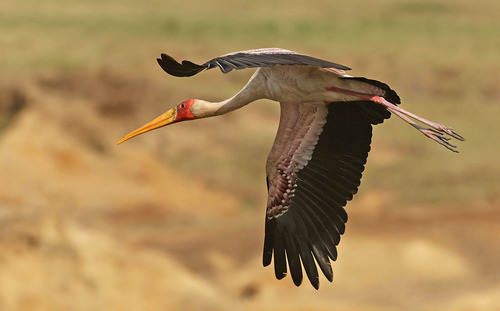
Yellow-billed Stork
Mycteria ibis
With its neon-yellow bill and delicate pink-tinted wings, the Yellow-billed Stork is the elegant dancer of Africa's wetlands. Watch for its unique 'foot-stirring' hunt as it wades through shallow waters with prehistoric grace.
Quick Identification
Size
Length: 90–105 cm (35–41 in); Wingspan: 150–165 cm (59–65 in); Weight: 1.2–2.3 kg (2.6–5.1 lb)
Colors
White body plumage with a pinkish wash on upper wings; black flight feathers and tail; bright yellow bill; red facial skin; pinkish-red legs.
Key Features
- Bright yellow, slightly decurved bill
- Bare red skin on the face extending behind the eye
- Black tail and wing tips contrasting with a white/pink body
- Long, spindly pinkish-red legs
- Stirring motion of the feet while foraging in water
When You’ll See Them
Sightings on EverydayEarth
Jun 17, 2026
A Yellow-billed Stork stands motionless at the water's edge in the foreground. In the background, several Impalas are scattered across the hillside, grazing on the dry winter grass. The camera pans slowly across the scene, showing the wide expanse of the woodland habitat.
Geographic range
Where Does the Yellow-billed Stork Live?
The Yellow-billed Stork is a native icon of the African continent, thriving across nearly the entire region south of the Sahara Desert. Its core range spans from the wetlands of Senegal and Ethiopia down to the northern reaches of South Africa, while also maintaining a significant and stable population on the island of Madagascar. These birds are highly nomadic, frequently traversing countries like Botswana, Kenya, and Tanzania as they track the seasonal flooding of pans and the receding waters of major river systems.
Basemap © OpenStreetMap contributors
Behavior
The Yellow-billed Stork is a patient and methodical hunter, often seen wading through shallow waters with its bill partially submerged. Unlike some herons that hunt by sight, these storks rely heavily on touch. They use a fascinating technique called 'foot-stirring,' where they use one foot to churn up the mud or vegetation, startling fish and crustaceans into their open beak, which snaps shut with incredible speed.
These are social birds, often found in small groups or alongside other waders like herons and ibises. While they are generally quiet, they may produce bill-clattering sounds during the breeding season. They are colonial nesters, often building large stick platforms in trees overlooking water, sometimes sharing the same 'bird city' with various other species. They are largely indifferent to humans if not approached too closely, making them excellent subjects for observation.
EverydayEarth exclusive
Camera Tips
To capture the best footage of a Yellow-billed Stork, position your camera at the very edge of a shallow water source, such as a garden pond or a wetland periphery. Set the camera at a low angle—roughly 12 to 18 inches off the ground—to catch the stunning reflection of their white plumage and yellow bill on the water's surface. Because these birds move with a slow, deliberate gait interrupted by sudden bill snaps, use a high-speed trigger setting to ensure you don't miss the feeding action.
If you are trying to attract them to a specific spot, they are drawn to areas with clear, shallow water where they can see and feel for prey. While you shouldn't feed wildlife directly, maintaining a healthy, chemical-free pond that supports local frog and small fish populations is the most natural 'bait' you can provide. These storks are most active during the cooler morning and late afternoon hours, so ensure your camera is programmed to be highly sensitive during these windows.
Pay close attention to lighting; the bright white feathers of the stork can easily 'blow out' or become overexposed in harsh midday sun. Aim your camera toward the west for morning shots or the east for afternoon shots to utilize soft, golden hour backlighting. If your camera supports video, set it to 30-second clips, as the 'foot-stirring' behavior is one of the most interesting biological displays you can record in the backyard wild.
Similar Species
Species that look similar or are commonly confused with Yellow-billed Stork.
Wood Stork
Found only in the Americas; has a dark, featherless head and neck compared to the Yellow-billed's red face.
African Openbill
Much smaller and entirely dark brown or black, with a unique gap in its bill used for eating snails.
Great Egret
All-white plumage without the black tail/wings, and a much thinner, straight yellow bill without the red facial skin.
Frequently Asked Questions
Record Yellow-billed Stork at your habitat
Connect a camera to start building your own species record — AI identifies every visitor automatically.