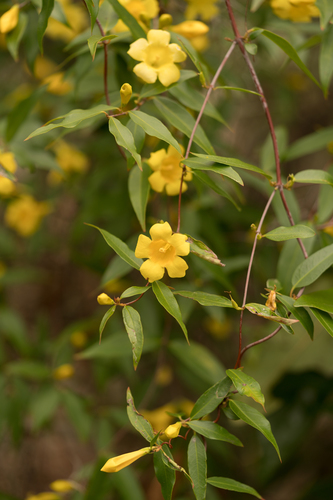
yellow jessamine
Gelsemium sempervirens
The golden herald of southern spring, Yellow Jessamine drapes the landscape in fragrant, trumpet-shaped blooms. This hardy evergreen vine is as famous for its sweet perfume as it is for its vigorous climbing ability.
Quick Identification
Size
Vine length of 10-20 feet (3-6 meters); flowers 1-1.5 inches (2.5-4 cm) long
Colors
Bright canary-yellow flowers often with orange throats; dark, glossy green foliage; stems are reddish-brown
Key Features
- Trumpet-shaped yellow flowers with five lobes
- Glossy, lance-shaped evergreen leaves
- Twining woody stems without tendrils
- Sweet, honey-like fragrance
When You’ll See Them
Behavior
Yellow Jessamine is a vigorous evergreen climber known for its ability to quickly cover fences, arbors, and trees. It is one of the earliest plants to bloom in the spring, often starting as early as February in the southern United States. Its growth habit is twining, meaning it wraps its woody stems around supports rather than using tendrils or adhesive pads.
While the plant provides a stunning visual display and a sweet scent, it is highly toxic to humans and most livestock if ingested. It serves as an important early-season nectar source for native bees and butterflies, though there is some evidence that its nectar can be toxic to honeybees if they consume it in large quantities without other forage options available.
EverydayEarth exclusive
Camera Tips
To capture the spectacular blooming phase of Yellow Jessamine, mount your camera at eye level (approx. 4-5 feet) facing a sunny section of the vine. Use a side-lighting angle during the early morning hours; the 'golden hour' sunlight emphasizes the waxy texture of the yellow petals and prevents the bright color from appearing overexposed or 'blown out' in your images.
This species is a perfect candidate for time-lapse photography. Set your camera to take a shot every 15 to 30 minutes over a three-day period during a warm spring week. This will allow you to see the tightly wound buds spiral open into their classic trumpet shape. If your camera has a macro lens or a close-up mode, aim it directly at a cluster of flowers to capture the delicate orange veins inside the throat of the bloom.
Because Yellow Jessamine is a magnet for early pollinators, it’s a great spot to set a 'motion trigger' for insect activity. Use a high shutter speed to freeze the motion of bumblebees or the occasional early-season butterfly. If you are using a trail camera to monitor the vine, place it near a bird feeder with the Jessamine in the background; the dense evergreen leaves provide an excellent natural backdrop for winter bird photography, even when the flowers aren't in bloom.
Similar Species
Species that look similar or are commonly confused with yellow jessamine.
Swamp Jessamine
Blooms later in the spring and has flowers that lack the sweet fragrance of the Carolina variety.
Winter Jasmine
A non-climbing shrub with deciduous leaves and flowers that lack the distinct trumpet-like throat of the jessamine.
Japanese Honeysuckle
An invasive vine with hairy stems and highly fragrant, thin-petaled flowers that transition from white to yellow.
Frequently Asked Questions
Record yellow jessamine at your habitat
Connect a camera to start building your own species record — AI identifies every visitor automatically.