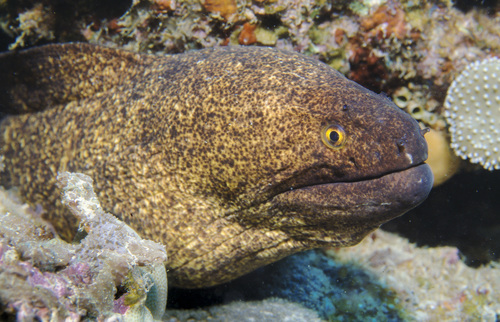
Yellowmargin Moray
Gymnothorax flavimarginatus
The Yellowmargin Moray is a master of the reef's shadows, identifiable by its striking leopard-spotted skin and a signature yellow glow along its tail. A powerful nocturnal hunter, this eel is a vital part of the Indo-Pacific marine ecosystem.
Quick Identification
Size
Typically 1.2 to 1.8 metres (4 to 6 feet), though exceptional individuals can reach 2.4 metres (8 feet) in length.
Colors
Yellowish to light brown base color densely covered in dark brown or black speckles resembling a leopard pattern. The tail features a distinct yellow-green margin, and there is a prominent black blotch at the gill opening.
Key Features
- Large black spot covering the gill opening
- Yellow-greenish margin along the rear of the fins
- Dense leopard-like dark speckling over a pale body
- Blunt snout with a massive, powerful jaw
- Often seen with mouth open to pump water over gills
When You’ll See Them
Geographic range
Where Does the Yellowmargin Moray Live?
This species is widely distributed across the tropical waters of the Indo-Pacific region. Its range extends from the eastern coast of Africa and the Red Sea across the Indian Ocean to the islands of the central Pacific, including Hawaii and the Tuamotus. While they are most abundant in the heart of the Coral Triangle, they can be found as far north as southern Japan and as far south as the Great Barrier Reef in Australia.
Basemap © OpenStreetMap contributors
Behavior
The Yellowmargin Moray is a formidable predator that commands respect on the reef. Primarily nocturnal, these eels spend their daylight hours tucked into deep crevices or under coral ledges, often with only their heads protruding. While their habit of constantly opening and closing their mouths may look aggressive, it is actually a vital respiratory function used to pump oxygen-rich water over their gills. They are solitary creatures that maintain a home range, though they are not strictly territorial toward all other species.
These eels are known for their high intelligence compared to other fish and have been observed engaging in cooperative hunting with species like the groupers. In these instances, the eel flushes prey out of tight spots where the grouper cannot reach, and vice versa. While generally shy around humans, they can become habituated to divers. However, they possess a powerful bite and sharp teeth, so they should always be observed from a respectful distance without attempting to feed or touch them.
EverydayEarth exclusive
Camera Tips
Capturing a Yellowmargin Moray on an underwater trail camera requires a focus on 'structure.' These eels are cavity dwellers, so the best placement is near a known crevice or 'apartment' in the reef where an eel has been spotted during the day. Mount your camera at a slight upward angle roughly 12-18 inches from the entrance of the hole. Because they are most active at night, a camera with high-quality infrared or white-light LEDs is essential to capture the intricate leopard-like patterns on their skin.
If you are using a camera in a backyard dock or a private reef area, ensure the housing is weighted or securely strapped to a permanent reef structure to prevent it from being moved by currents or curious marine life. Using a bait cage filled with oily fish (like sardines) can draw an eel out of its burrow and into the full frame of your camera, providing a rare look at its full length and swimming motion. Be sure the bait is secured so the eel doesn't simply drag it away and out of sight.
Set your camera to record short video clips (15-30 seconds) rather than still photos. Morays move with a fascinating, serpentine grace that is much better appreciated in motion. Look for 'cleaning stations'—areas where small shrimp or wrasse congregate. Morays often visit these spots to have parasites removed, and the interaction between the eel and the tiny cleaners makes for incredible footage. Ensure your trigger sensitivity is set to high, as the eel’s slow, deliberate movements may not always trigger less sensitive sensors.
Similar Species
Species that look similar or are commonly confused with Yellowmargin Moray.
Giant Moray
Much larger (up to 3m) with larger black blotches and a darker, more brownish head without the yellow fin margin.
Whitemargin Moray
Has a distinct white border on its fins instead of the yellow-green margin seen in the Yellowmargin.
Honeycomb Moray
Features a much more regular, mesh-like black pattern on a white or cream background.
Frequently Asked Questions
Record Yellowmargin Moray at your habitat
Connect a camera to start building your own species record — AI identifies every visitor automatically.